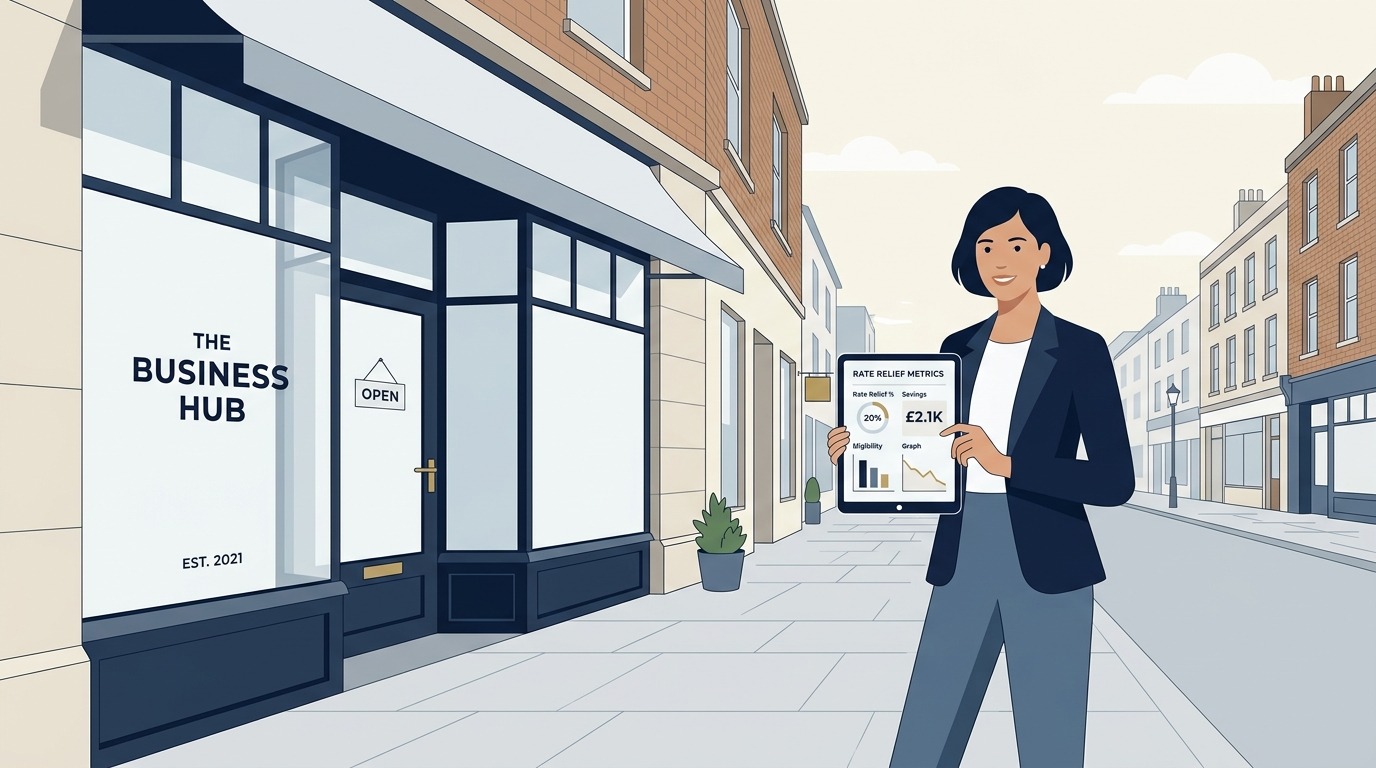
Executive Brief: Commercial property overheads represent one of the most substantial fixed operational burdens facing British enterprises. According to financial data published by the Local Government Association Business Rates Portal, non-domestic property rates generate over £26 billion annually for local authorities across England and Wales. For independent retailers, professional services firms, light industrial workshops, and boutique offices, understanding the precise statutory mechanics of Small Business Rates Relief can reduce non-domestic rates liabilities by up to 100 percent, directly safeguarding working capital and commercial liquidity.
Quick Answer: How Does Small Business Rates Relief Work in the UK?
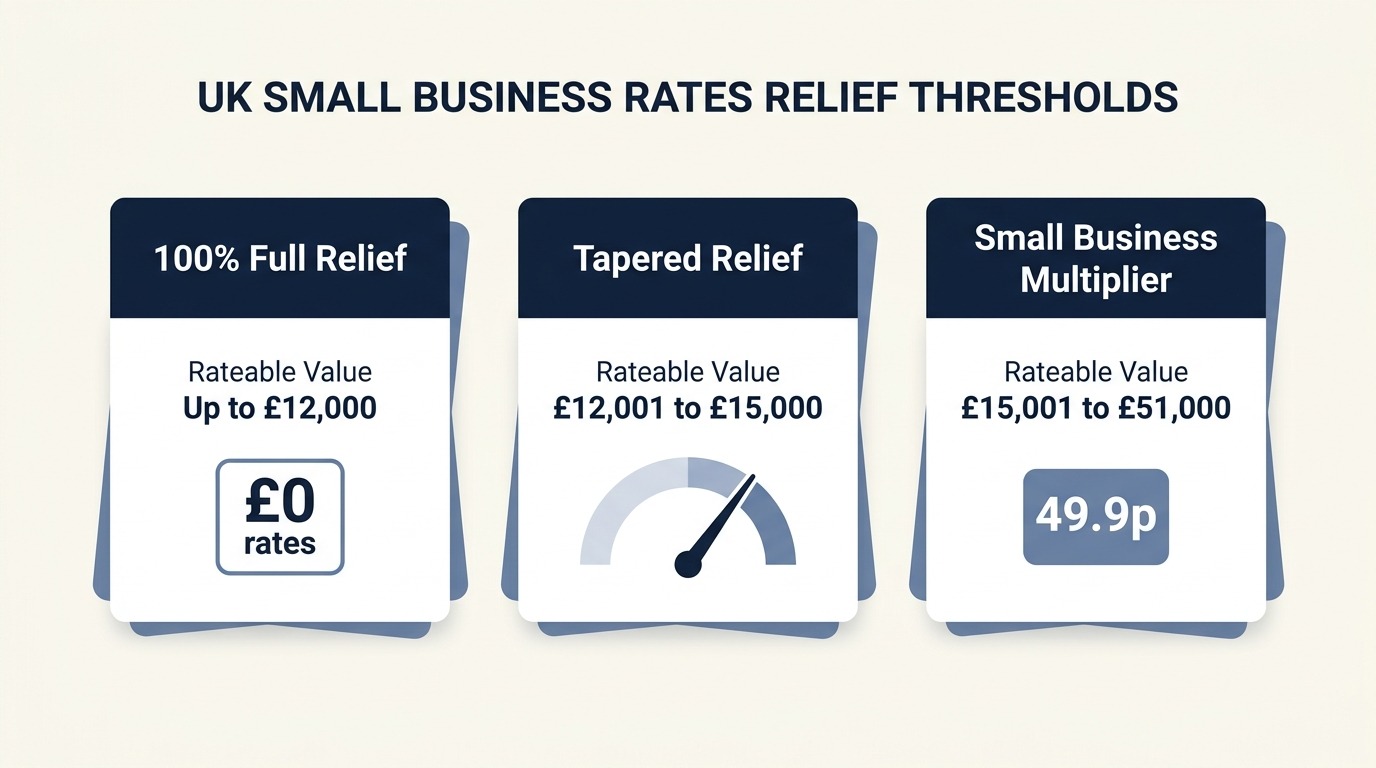
Small Business Rates Relief (SBRR) is a statutory government tax relief scheme in England that lowers or entirely eliminates non-domestic property rates for eligible commercial occupiers. If your business occupies a single commercial property with a rateable value (RV) of £12,000 or less, you receive 100 percent rate relief, paying zero pounds in business rates for the financial year.
For commercial properties with a rateable value between £12,001 and £15,000, relief decreases on a sliding taper from 100 percent down to zero percent. In addition, qualifying businesses with a rateable value below £51,000 have their annual bill calculated using the lower Small Business Multiplier (49.9p in the pound for 2026/27) rather than the standard national multiplier (54.6p).
Key Takeaways for UK Business Owners, Directors and Tenants
- 100% Rate Exemption: Properties with an official rateable value up to £12,000 pay £0 in business rates if they meet the single property condition.
- Tapered Relief Band: Premises valued between £12,001 and £15,000 receive proportional sliding-scale percentage discounts.
- The Second Property Rule: You can take on an additional commercial unit without losing relief on your main property if the second unit has a rateable value under £2,899 and total combined rateable value remains under £20,000 (£28,000 in London).
- 12-Month Grace Period: Taking on an additional property that would normally disqualify you triggers a statutory 12-month extension on your original relief.
- Local Council Application: While some local authorities apply SBRR automatically upon registration, business owners must actively submit a relief declaration if the discount is missing from their annual demand notice.
Understanding UK Business Rates: Rateable Value, Multipliers, and the VOA
Non-domestic rates, commonly known as business rates, are levied on most non-residential properties in England, including shops, offices, warehouses, factories, guest houses, and storage yards. The tax is calculated using two primary statutory variables determined by central government agencies:
- Rateable Value (RV): Assessed by the Valuation Office Agency (VOA), an executive agency of HM Revenue and Customs. The rateable value represents the estimated open market annual rental value of the property on a fixed statutory valuation date. The current valuation list is based on commercial property rental values from 1 April 2021, which took statutory effect on 1 April 2023.
- Uniform Business Rate Multiplier: Set annually by HM Treasury, the multiplier dictates the pence-per-pound rate applied to your property’s rateable value. For the 2026/27 rating year, the standard business multiplier is 54.6p, while the small business multiplier is frozen at 49.9p for properties with a rateable value below £51,000.
Without relief, a commercial office with a rateable value of £10,000 would incur an annual rates bill of £4,990 (£10,000 multiplied by 0.499). Securing Small Business Rates Relief eliminates this payment entirely, delivering immediate cash savings that can be redirected toward inventory, staff hiring, or commercial property insurance in the UK.
Small Business Rates Relief Thresholds and the Taper Formula Explained
Statutory eligibility for SBRR in England depends primarily on the rateable value of the commercial hereditament (the legal term for a taxable property unit) and the number of properties occupied by your enterprise.
1. Full 100% Relief (Rateable Value Up to £12,000)
If your enterprise occupies only one commercial property in England, and that property has an official rateable value of £12,000 or less, you qualify for 100 percent rate relief. Your annual rates bill is £0. You remain legally responsible for notifying the council of your occupation, but no rates payments are due.
2. Tapered Sliding Scale Relief (Rateable Value £12,001 to £15,000)
If your sole commercial property has a rateable value between £12,001 and £15,000, you receive tapered rate relief. The statutory discount decreases on a linear sliding scale from 100 percent down to zero percent, falling by approximately 33.33 percent for every £1,000 increase in rateable value.
The precise statutory formula used by local authority billing departments is calculated as follows:
For example, if your retail shop has an assessed rateable value of £13,500:
- Subtract the rateable value from the upper threshold: £15,000 – £13,500 = £1,500.
- Divide by the taper range: £1,500 / £3,000 = 0.50 (50 percent relief).
- Calculate gross unadjusted bill: £13,500 * 0.499 = £6,736.50.
- Apply the 50 percent relief discount: Your final rates payable amount is £3,368.25.
3. Small Business Multiplier Protection (£15,001 to £50,999)
Properties with a rateable value between £15,001 and £50,999 do not receive percentage-based discounts under SBRR. However, provided the property is occupied, the local council will automatically calculate the annual charge using the lower small business multiplier (49.9p) rather than the standard national multiplier (54.6p). On a commercial property valued at £40,000, this multiplier difference saves £1,880 annually in business rates.
| Property Rateable Value (RV) | Statutory SBRR Discount | Applicable Multiplier (2026/27) | Gross Annual Bill (No Relief) | Net Rates Payable After SBRR |
|---|---|---|---|---|
| £8,000 | 100% Full Relief | 49.9p | £3,992.00 | £0.00 |
| £12,000 | 100% Full Relief | 49.9p | £5,988.00 | £0.00 |
| £13,000 | 66.67% Tapered Relief | 49.9p | £6,487.00 | £2,162.33 |
| £14,000 | 33.33% Tapered Relief | 49.9p | £6,986.00 | £4,657.33 |
| £15,000 | 0% (Relief Threshold Ends) | 49.9p | £7,485.00 | £7,485.00 |
| £25,000 | Small Business Multiplier Only | 49.9p | £13,650.00 (at 54.6p) | £12,475.00 (saves £1,175) |
The Multi-Property Trap: How Expanding Premises Affects SBRR
One of the most frequent financial surprises encountered by expanding small enterprises is the sudden loss of Small Business Rates Relief upon acquiring a second commercial site. The statutory rules governing additional commercial properties are strictly enforced by local council billing authorities:
The Additional Property Qualification Conditions
Under official GOV.UK Small Business Rate Relief Guidance, an occupier can retain SBRR on their primary commercial premises while occupying additional commercial units only if all of the following conditions are met:
- Individual Cap on Additional Units: None of your additional commercial properties has an individual rateable value exceeding £2,899.
- Total Aggregate Cap: The combined total rateable value of all your commercial properties across England does not exceed £19,999 outside Greater London, or £27,999 within Greater London.
If you satisfy these criteria, you will continue to receive relief on your primary property (provided its rateable value is below £15,000). You will pay standard small business rates on the secondary units, but your primary property discount remains protected.
The 12-Month Grace Period for Commercial Expansion
If your enterprise takes on a second commercial property with a rateable value of £2,900 or more, you would normally lose all SBRR immediately. To prevent growing businesses from facing an immediate cash crunch, statutory legislation grants a 12-month grace period.
During this 12-month window, you continue receiving Small Business Rates Relief on your main property, giving your business time to stabilize revenue in the new location. Once the 12 months elapse, relief on your original property terminates, and both premises will be billed at standard rates according to their individual rateable values.
Interaction with Other Business Rates Reliefs in 2026/27
Small Business Rates Relief operates alongside several other government property relief initiatives. Understanding how these schemes interact ensures business owners maximize their annual tax savings and maintain accurate financial forecasting alongside reducing UK corporate tax liability.
Retail, Hospitality and Leisure (RHL) Relief
High street shops, restaurants, pubs, cafes, hotels, and music venues that do not qualify for 100 percent SBRR may qualify for the Retail, Hospitality and Leisure relief scheme. Following recent budgetary adjustments, eligible businesses receive a 40 percent discount on their net business rates bill, capped at £110,000 per business across all properties. Councils apply SBRR first, and then apply RHL relief to any remaining net charge.
Supporting Small Business (SSB) Relief Scheme
The Supporting Small Business scheme was introduced to protect occupiers whose rateable value increased during the 2023 VOA revaluation, causing them to lose some or all of their SBRR entitlement. The scheme caps annual bill increases, ensuring that eligible businesses do not experience sharp, unexpected jumps in their business rates liabilities from one financial year to the next.
Rural Rate Relief
Businesses operating in designated rural settlements with populations under 3,000 can claim Rural Rate Relief. Qualifying general stores, post offices, village food shops, and petrol stations with rateable values up to statutory limits receive 100 percent rate relief, supporting essential commercial services in local communities.
| Relief Scheme | Target Sector | Maximum Discount Level | Statutory Conditions & Caps |
|---|---|---|---|
| Small Business Rates Relief (SBRR) | All commercial sectors occupying small units | 100% under £12k RV; sliding taper to £15k | Single property rule; additional units under £2,899 RV |
| Retail, Hospitality & Leisure (RHL) | Shops, pubs, restaurants, entertainment venues | 40% net discount | Statutory cash cap of £110,000 per commercial enterprise |
| Supporting Small Business (SSB) | Businesses losing SBRR due to revaluations | Annual bill increase capped | Must have received SBRR prior to the valuation increase |
| Rural Rate Relief | Village stores, post offices, rural pubs | 100% Full Relief | Settlement population under 3,000; sole commercial provider |
Step-by-Step Guide: How to Apply for Small Business Rates Relief
Securing your rates relief requires coordinated action with both the national valuation authority and your local council billing department. Follow this operational checklist:
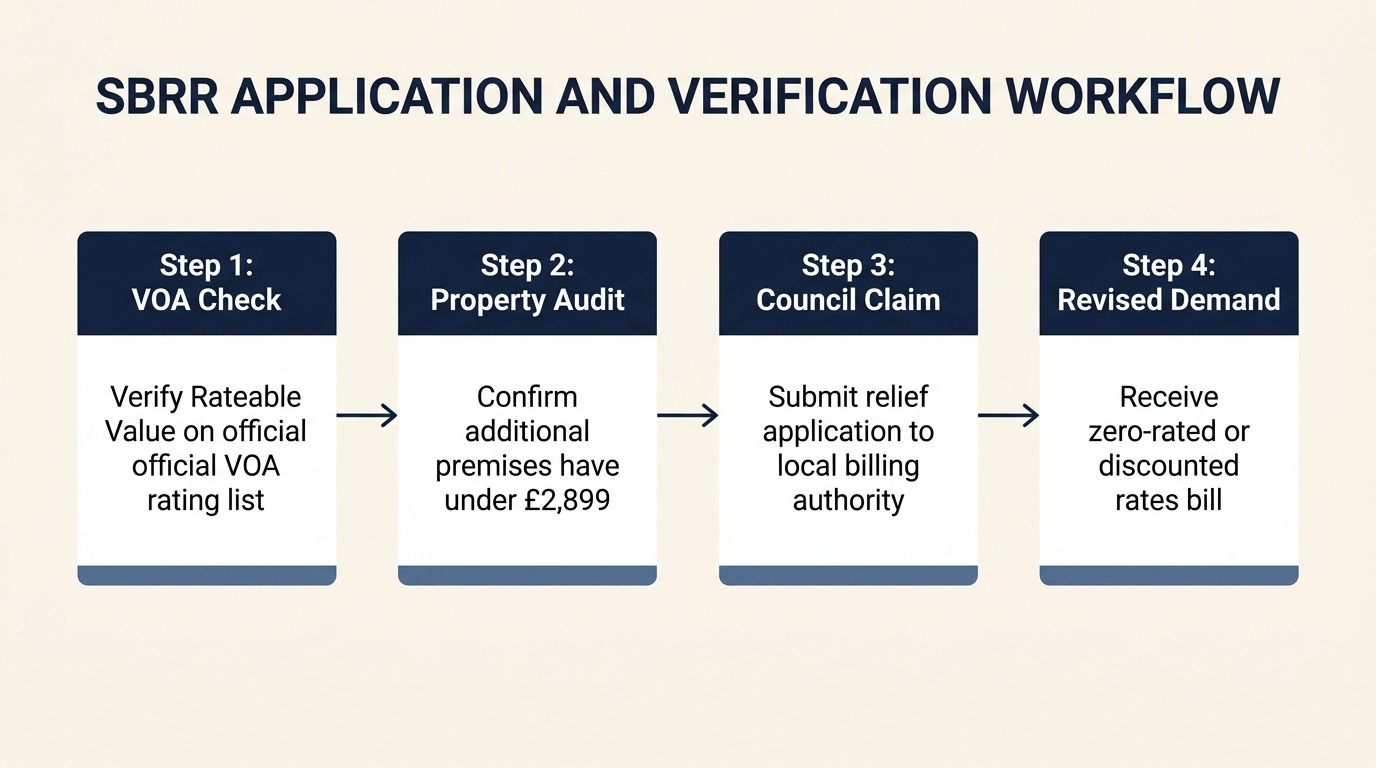
Step 1: Check Your Property’s Rateable Value on the VOA Rating List
Before contacting your local authority, verify your exact rateable value using the official Valuation Office Agency Business Rates Valuation List. Search by your commercial postcode or street address. Review the property valuation breakdown, which details internal floor areas, secondary storage spaces, and car parking allocations used to derive the valuation.
Step 2: Conduct an Internal Property and Lease Audit
Confirm that your business meets the single property test. If your company operates multiple trading locations or holds leases on secondary storage lockers, check the individual rateable value of each unit. Ensure no secondary unit exceeds £2,899, and that the combined total remains strictly below £19,999 (£27,999 in Greater London).
Step 3: Submit an SBRR Application to Your Local Council Billing Authority
Business rates are billed and collected directly by your local borough, district, or unitary council, not by central government. Visit your council’s business rates web portal and locate the Small Business Rates Relief application form. You will need to provide:
- Your Business Rates Account Reference Number (found in the top right corner of your annual demand notice).
- The exact trading name and legal structure of the occupying entity (Sole Trader, Partnership, or Limited Company).
- A signed legal declaration confirming that the property is your only commercial premises in England, or listing all additional units with their respective rateable values.
Step 4: Audit Your Revised Demand Notice
Once your council processes your declaration, they will issue a revised annual rate demand. If your property has a rateable value of £12,000 or lower, your revised bill will show a net charge of £0.00. Keep this document securely filed for your company records and synchronize your business records with your HMRC business tax account.
Challenging Your Rateable Value: The VOA Check, Challenge, Appeal Process
If your property has a rateable value just above a relief threshold (for instance, £12,500 or £15,200), successfully reducing the valuation by a modest margin can unlock thousands of pounds in annual rate relief. Occupiers can challenge their valuation through the VOA’s formal three-stage process:
- Check Stage: Review the factual property details recorded on the VOA system (such as internal square metres and ancillary spaces). If you discover factual errors (such as incorrect ceiling heights or over-measured retail zones), submit corrected measurements with photographic evidence. The VOA must respond within 12 months.
- Challenge Stage: If the factual details are accurate but you believe the valuation is excessive based on comparable local commercial rents, you can submit a formal Challenge within four months of the Check decision. You must provide a proposed alternative valuation and supporting rental evidence from nearby units.
- Appeal Stage: If you cannot reach an agreement with the VOA, you may submit an Appeal to the independent Valuation Tribunal for England (VTE) within four months of the Challenge decision notice.
Frequently Asked Questions About Small Business Rates Relief
Can a limited company claim Small Business Rates Relief on multiple premises?
No. Small Business Rates Relief is granted per business, not per property. If a limited company leases three separate retail shops with rateable values of £10,000 each, it will only receive relief on one shop for a maximum of 12 months, after which full rates will be payable on all three units because the secondary units breach the £2,899 individual cap.
Does a business operating from home pay business rates?
Generally, home-based businesses in the UK do not pay business rates if they use a standard room as a domestic home office. However, if you convert part of your residential home exclusively for commercial purposes (such as a customer-facing beauty salon, photographic studio, or retail workshop), or employ staff on-site, the VOA may assess that specific room as a non-domestic hereditament subject to business rates.
Can Small Business Rates Relief be backdated to previous financial years?
Yes. In England, you can generally backdate an SBRR claim to the start of the current rating list (1 April 2023) or the date your commercial occupation began, provided your business satisfied all statutory eligibility criteria throughout that period. Any overpaid rates will be refunded directly to your corporate bank account or credited against future liabilities.
What happens to SBRR if I move premises mid-year?
When you relocate, your council will adjust your business rates account on a pro-rata daily basis. You will need to submit a fresh SBRR application for your new commercial property with the relevant local authority, as rates relief does not transfer between addresses automatically.
Who is legally responsible for paying business rates, the landlord or the tenant?
Under English commercial property law, the legal occupier of the premises is responsible for paying business rates. If a tenant signs a commercial lease, they are liable for the rates demand notice. However, in serviced offices or shared coworking facilities, landlords often include business rates in the monthly inclusive rent licence fee.
Protecting Your Commercial Cash Flow
Navigating commercial property taxation is an essential operational discipline for any growing British business. Small Business Rates Relief represents one of the most generous tax exemptions available in the UK tax code, providing up to 100 percent relief for small premises and shielding growing enterprises from substantial overheads. By verifying your rateable value on the official VOA list, structuring your commercial leases around the secondary property rules, and promptly claiming your statutory entitlements with your local billing authority, you ensure that every pound of available relief directly strengthens your business cash flow and long-term commercial resilience.