
According to commercial lending data compiled by UK Finance, annual gross lending across the British development sector exceeded £14.2 billion, with specialist non-bank lenders and challenger institutions funding over 55% of all ground-up residential schemes. In an economic environment defined by elevated material costs, planning delays, and fluctuating buyer demand, securing appropriate funding structures represents the foundation of project profitability. For property developers and building contractors, miscalculating finance costs or selecting the wrong debt layer can erode profit margins before groundworks commence.
Securing external capital for construction is distinct from arranging conventional investment debt. Obtaining property development finance in the United Kingdom requires a clear grasp of multi-tier capital stacks, loan-to-gross-development-value metrics, staged construction drawdowns, and independent monitoring audits. This manual provides a practical breakdown of how commercial development facilities operate, how lenders evaluate project risk, how interest roll-up mechanisms preserve working capital, and how developers structure exits through open-market sales or portfolio refinances.
Quick Answer: What Is Property Development Finance?
Property development finance is a short-term commercial loan used to fund the purchase and construction costs of residential, commercial, or mixed-use building schemes. Capital is disbursed in staged drawdown tranches in arrears, released only after an Independent Monitoring Surveyor (IMS) inspects and verifies completed construction milestones. Senior debt lenders typically advance up to 70% to 75% of the projected Gross Development Value (LTGDV) and up to 85% to 90% of total project costs (LTC). Loan terms range from 12 to 36 months, with interest rolled up into the facility and repaid upon practical completion through property sales or term refinancing.
Key Takeaways for UK Property Developers
- Two Critical Lending Caps: Lenders underwrite based on two metrics: Loan-to-Cost (LTC, typically 85%–90%) and Loan-to-Gross-Development-Value (LTGDV, capped at 65%–75%).
- Funds Released in Arrears: Build capital is not paid out in a lump sum. Tranches are drawn down monthly following verified sign-offs by an Independent Monitoring Surveyor.
- Cash-Free Build Phase via Roll-Up: Interest and finance fees are rolled up into the gross loan facility, meaning developers make zero monthly cash interest payments during active construction.
- The Capital Stack Matters: Combining senior debt with mezzanine finance or private equity reduces required cash deposits down to 10% of total project costs.
- Planning Is Non-Negotiable: Lenders will not issue development facilities without full, detailed planning consent in place. Speculative sites without planning rely on raw land bridging debt.
How Property Development Finance Works in the UK
Property development finance is an interest-bearing, asset-backed lending facility designed specifically for ground-up construction, major structural conversions, or heavy commercial refurbishments. Unlike standard commercial mortgages that advance capital based on historical trading accounts, development loans are underwritten on the project’s future completed value, known as the Gross Development Value (GDV).
The financing facility operates in two distinct phases:
- The Land Acquisition Advance: On day one of completion, the lender advances a portion of the purchase price for the land or unmodernised building. This initial advance typically covers 50% to 70% of the site’s current open-market value with planning consent. The developer provides the remaining capital as their equity contribution.
- The Staged Construction Drawdowns: The remaining loan facility is reserved strictly for construction works. The lender holds build funds and releases them in monthly drawdown tranches in arrears. As contractors complete phases (foundations, superstructure, wind and watertight stages, first fix, second fix), an Independent Monitoring Surveyor inspects the works and certifies the drawdown.
A central advantage of development lending is the interest roll-up mechanism. Because construction sites generate zero operational income while works are underway, lenders roll up interest charges directly into the loan balance. The borrower makes no monthly cash interest payments. Instead, interest compounds and is paid in full at practical completion, funded by final unit sales or a term exit mortgage.
Key Underwriting Metrics: LTGDV vs. LTC Explained
When assessing a development proposal, credit committees apply two strict mathematical ceilings. Whichever calculation yields the lower borrowing figure becomes the developer’s maximum loan limit:
| Metric Name | Standard Industry Range | Definition & Calculation | Risk Significance for Lenders |
|---|---|---|---|
| Loan-to-Cost (LTC) | 80% to 90% of total costs | Total Loan divided by Total Development Costs (Site + Build + Fees) | Measures developer equity committed to the scheme |
| Loan-to-Gross-Development-Value (LTGDV) | 65% to 75% of finished GDV | Gross Facility (including interest) divided by Final Market Value | Protects lender against housing market downturns during construction |
| Developer Profit on Cost | 18% to 25% minimum | Net Developer Profit divided by Total Project Costs | Ensures financial buffer if material prices or labour rates rise |
Consider a practical example. A developer acquires an urban site for £800,000, with build costs of £1,000,000, professional fees, and finance costs of £300,000, for a Total Cost of £2,100,000. The projected Gross Development Value upon completion of six residential townhouses is £3,000,000.
If a senior lender offers 85% LTC and 70% LTGDV, the calculations proceed as follows:
- LTC Limit: 85% of £2,100,000 = £1,785,000
- LTGDV Limit: 70% of £3,000,000 = £2,100,000
Because the LTC ceiling is lower, the lender caps total borrowing at £1,785,000. The developer must supply the remaining £315,000 as cash equity. At completion, after clearing the debt facility, the developer captures £900,000 in gross trading profit, representing a 42.8% return on cost.
The Property Development Capital Stack: Layering Your Debt
Large-scale construction rarely relies on a single source of capital. Experienced developers assemble a “capital stack”, layering different forms of debt and equity to minimize their personal cash commitment while preserving project control.
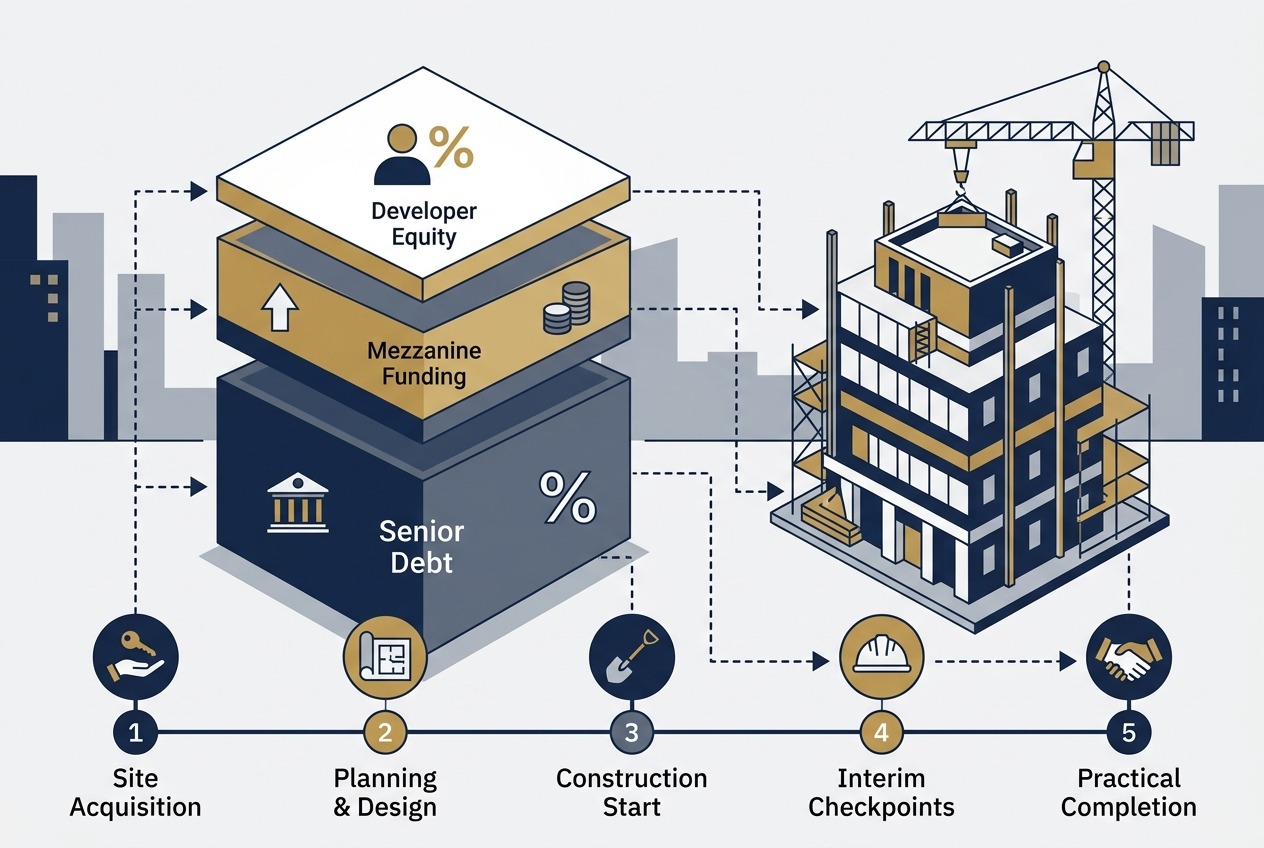
| Capital Layer | Typical Funding Proportion | Security Rank | Indicative Cost of Capital |
|---|---|---|---|
| Senior Debt | Up to 60%–70% GDV (80% LTC) | First Legal Charge over site and assets | 7.5% to 11.5% per annum |
| Mezzanine Finance | Tops up borrowing to 90% LTC | Second Legal Charge behind senior lender | 14.0% to 20.0% per annum |
| Equity / Joint Venture | Remaining 10% to 20% of project costs | Ordinary shares / Subordinated debt | 30% to 50% profit share agreement |
Senior debt sits at the base of the capital stack. The senior lender holds a first legal charge over the freehold or leasehold site, alongside corporate debentures and personal guarantees from company directors. Because senior debt occupies the lowest risk position, it carries the most competitive pricing.
When a developer seeks to conserve cash or run multiple simultaneous projects, mezzanine finance bridges the funding gap between senior debt and available equity. Mezzanine lenders take a second legal charge over the property and enter into an intercreditor deed with the senior lender. While mezzanine rates are higher, utilizing this capital layer allows developers to commence construction with as little as 10% cash input.
To evaluate regulatory obligations when dealing with commercial lenders, consult Financial Conduct Authority regulatory standards to ensure brokers and commercial intermediaries operate transparently. While commercial lending to limited companies is largely exempt from consumer credit regulations, credit standards remain strict across all institutional panels.
The Staged Drawdown Mechanism and the Role of the IMS
Lenders never release construction funds directly to a developer’s current account. Capital is released through a structured milestone process supervised by an Independent Monitoring Surveyor (IMS).
The IMS is a professional surveyor appointed by the lender, though paid for entirely by the borrower. The surveyor’s mandate begins prior to loan drawdown with the Initial Project Audit. In this audit, the IMS evaluates the developer’s budget, planning consents, structural calculations, environmental reports, site investigation data, and building contracts.
During active construction, the staged drawdown process follows a precise monthly cycle:
- Contractor Valuation Submission: At the end of each build month, the main contractor submits an interim payment application documenting works completed and materials on site.
- Physical Site Inspection: The IMS visits the site to verify that stated works are physically executed to required technical standards. The surveyor verifies that roof trusses are installed, damp-proof courses are certified, and building control notices are issued.
- Interim Report Issuance: The IMS produces an Interim Monitoring Report for the lender. The report certifies the value of works completed, confirms that remaining loan funds are sufficient to finish the scheme, and approves the drawdown figure.
- Capital Disbursement: Upon reviewing the IMS report, the lender’s finance desk transfers the approved capital tranches directly to the developer or building contractor, typically within three to five working days.
According to professional Royal Institution of Chartered Surveyors valuation guidance, independent monitoring protects both the bank and the developer from contractor over-billing. Strong site documentation, JCT contracts, and certified invoices prevent administrative delays during monthly drawdowns.
Interest Rates, Fees, and Cost Structures Explained
Evaluating development funding proposals requires analysing the total cost of capital rather than fixating solely on the headline interest rate. Finance costs fall into three main categories:
1. Interest Rates (Monthly vs. Annual)
Senior development debt pricing ranges from 7.5% to 11.5% per annum for experienced operators, or 0.65% to 1.1% per month for non-bank alternative lenders. Interest is calculated on drawn funds rather than the entire facility. If your total build facility is £1,000,000, you only pay interest on the £100,000 drawn in month one. As drawdowns increase month by month, interest calculations scale accordingly.
2. Arrangement and Exit Fees
Lenders charge an arrangement fee of 1% to 2% of the gross loan amount, deducted directly from the day-one advance. Exit fees range from 1% to 2%. Developers must examine the exit fee calculation carefully. An exit fee calculated as 1% of the gross loan amount is standard. An exit fee calculated as 1% of the Gross Development Value is significantly more expensive, adding thousands of pounds to total finance costs.
3. Professional and Legal Costs
Borrowers are responsible for all professional third-party expenses incurred by the lender. These include lender legal fees (£5,000 to £15,000 depending on project scale), the initial Red Book valuation (£2,500 to £7,000), the initial IMS project audit (£2,500 to £5,000), and monthly IMS inspection visits (£800 to £1,500 per visit).
| Cost Component | Typical Benchmark | Payment Timing | Cost Impact on £1.5M Facility |
|---|---|---|---|
| Arrangement Fee | 1.5% of loan facility | Deducted at completion | £22,500 |
| Rolled-Up Interest (Weighted) | 9.0% per annum on drawn funds | Rolled up; repaid at redemption | £85,000 to £110,000 |
| Exit Fee | 1.0% of loan amount | Repaid at facility redemption | £15,000 |
| Surveyor (IMS) Fees | Initial audit + 12 monthly visits | Paid monthly or retained in facility | £14,000 to £18,000 |
| Lender Legal Representation | Fixed legal fee agreed upfront | Paid in stages (undertaking required) | £8,000 to £12,000 |
Developer Eligibility and Underwriting Criteria
Commercial lenders evaluate both the project metrics and the executive team behind the development. While unencumbered real estate secures the debt, successful execution relies on developer capability.
Underwriting teams assess four primary pillars during credit reviews:
- Track Record and Past Completions: Lenders prefer borrowers who have completed two or three projects of similar scale and complexity within the past five years. First-time developers can overcome experience requirements by hiring an established main contractor under a fixed-price JCT contract, or by partnering with an experienced joint-venture development manager.
- Contracting and Procurement Strategy: Lenders insist on formal building contracts, most commonly Joint Contracts Tribunal (JCT) Design and Build agreements. The main contractor must carry adequate Public Liability, Employers’ Liability, and All-Risks insurance, backed by Performance Bonds and Collateral Warranties in favour of the lender.
- Planning Permissions and Statutory Approvals: Projects must possess full, unappealable planning consent. If the scheme involves conversion into shared housing or co-living units, understanding local HMO property development rules and Article 4 restrictions is vital to ensure end-use planning legality.
- Structural Warranties: All new residential builds require a recognized 10-year structural defect warranty (such as NHBC, Premier Guarantee, LABC, or Checkmate). Mortgage lenders funding future retail buyers will refuse to lend on properties lacking approved warranty certificates.
Exit Strategies: Repaying the Development Facility
Development finance is strictly temporary capital. Lenders mandate a viable, fully documented exit strategy before issuing loan terms. In the UK market, three primary exit mechanisms operate:
1. Open-Market Sales
The developer markets individual units off-plan or upon practical completion. As buyer sales complete, sale proceeds pass through solicitors directly to the lender to pay down the debt balance. Once the loan and rolled-up interest are satisfied, remaining proceeds flow to the developer as equity profit.
2. Refinancing into Long-Term Investment Debt
If the developer intends to retain the finished scheme as a rental asset, the exit involves transitioning onto commercial term debt. Securing structured limited company buy to let mortgages allows developers to refinance the asset based on completed market value, paying off the construction lender while generating ongoing rental income.
3. Development Exit Bridging Loans
If construction is finished but sales are slow due to market conditions, developers can secure a development exit bridge. Exit bridging rates are substantially lower than development build rates. This facility repays the original lender, lifts default fee pressures, and grants the developer an extra 12 to 18 months to sell units at full market value without discounting.
In cases where unexpected planning amendments or utility delays strain project cash flow, securing short-term cash flow lending for businesses provides temporary working capital to settle supplier accounts while preserving the main development timeline.
UK Development Lenders Comparison: High Street vs. Specialists
The UK commercial lending landscape is divided into three primary tiers, each serving distinct borrower profiles:
| Lender Tier | Key Providers | Typical Loan Sizes | Max LTGDV / Pricing Profile |
|---|---|---|---|
| High Street Banks | Barclays, NatWest, Lloyds, HSBC | £2,000,000 to £50,000,000+ | 55% to 65% LTGDV; Lowest rates (6.5%–8.5% p.a.); Strict criteria |
| Challenger Banks | Aldermore, Paragon, Shawbrook, Close Brothers, HTB | £1,000,000 to £25,000,000 | 65% to 70% LTGDV; Moderate rates (8.0%–10.5% p.a.); Flexible speed |
| Specialist Funds & Debt Funds | Octopus Real Estate, LendInvest, Together Commercial, Puma Property | £500,000 to £15,000,000 | 70% to 75% LTGDV; Higher rates (9.5%–12.5% p.a.); High leverage |
Developers exploring publicly backed regional programmes can consult the British Business Bank commercial lending guide to discover localized growth funds and debt support schemes designed to support SME housebuilders across the UK.
Frequently Asked Questions
What is the difference between property development finance and a bridging loan?
Bridging loans are short-term lump-sum advances (typically lasting 3 to 18 months) used to acquire property quickly or complete minor, non-structural refurbishments. Property development finance is specifically designed for major structural renovations or ground-up construction, where funds are advanced in staged drawdowns aligned with building milestones certified by an Independent Monitoring Surveyor.
Can first-time property developers secure development finance?
Yes, first-time developers can secure funding, though institutional criteria will be stricter. Lenders will generally cap borrowing at 65% LTGDV and require the developer to appoint an established main contractor under a fixed-price JCT Design and Build contract, hire an accredited project manager, or partner with an experienced joint-venture developer.
How much cash deposit does a developer need?
When using senior debt alone, developers typically need to contribute 15% to 20% of total project costs in cash equity. However, by combining senior debt with mezzanine finance or private equity, developers can lower their personal cash deposit down to 10% of total costs.
What happens if a construction project overruns its schedule?
If construction overruns the agreed loan term, the developer enters the penalty phase. Lenders will charge default interest rates (often 1% to 2% above the headline rate) and extension fees. To avoid severe financial penalties, developers should request an initial facility term that includes a 3-month construction and sales buffer, or arrange a development exit bridging loan before the facility expires.
Who pays for the Independent Monitoring Surveyor (IMS)?
The borrower is legally responsible for all IMS costs. The lender selects and instructs the surveyor, but the developer pays for the initial project appraisal (typically £2,500 to £5,000) and each subsequent monthly site inspection fee (£800 to £1,500). These fees are typically budgeted into the development appraisal and funded from the loan facility.
Can interest be rolled up on all development loans?
Yes. In the UK development market, almost all senior debt lenders roll up interest into the gross loan facility. Because construction projects generate no revenue until units are completed and sold, rolling up interest eliminates monthly debt servicing pressures for the developer.
What to Do Next: Developer Pre-Application Checklist
Approaching commercial lenders without adequate documentation delays credit approvals and increases finance costs. Developers should prepare a formal loan application pack containing the following documents:
- Detailed Development Appraisal: Submit an appraisal detailing land purchase price, gross internal floor areas, itemised build costs, professional fees, finance contingencies, and realistic Gross Development Value benchmarks.
- Planning Consent Documentation: Supply the full decision notice from the local planning authority, including all approved architectural drawings, Section 106 agreements, and Community Infrastructure Levy (CIL) liabilities.
- Contractor and Professional Team Profiles: Include company profiles for the appointed architect, structural engineer, and main building contractor, alongside proof of contractor insurance and 10-year structural warranty provider approvals.
- Executive Track Record Resume: Compile a visual portfolio detailing past completed projects, including site locations, build budgets, completion timelines, and achieved sale prices.
Development financing is a bespoke commercial negotiation. Work with an accredited National Association of Commercial Finance Brokers (NACFB) specialist to market your proposal across high street, challenger, and alternative debt panels.