Quick Answer: Invoice Factoring vs Discounting
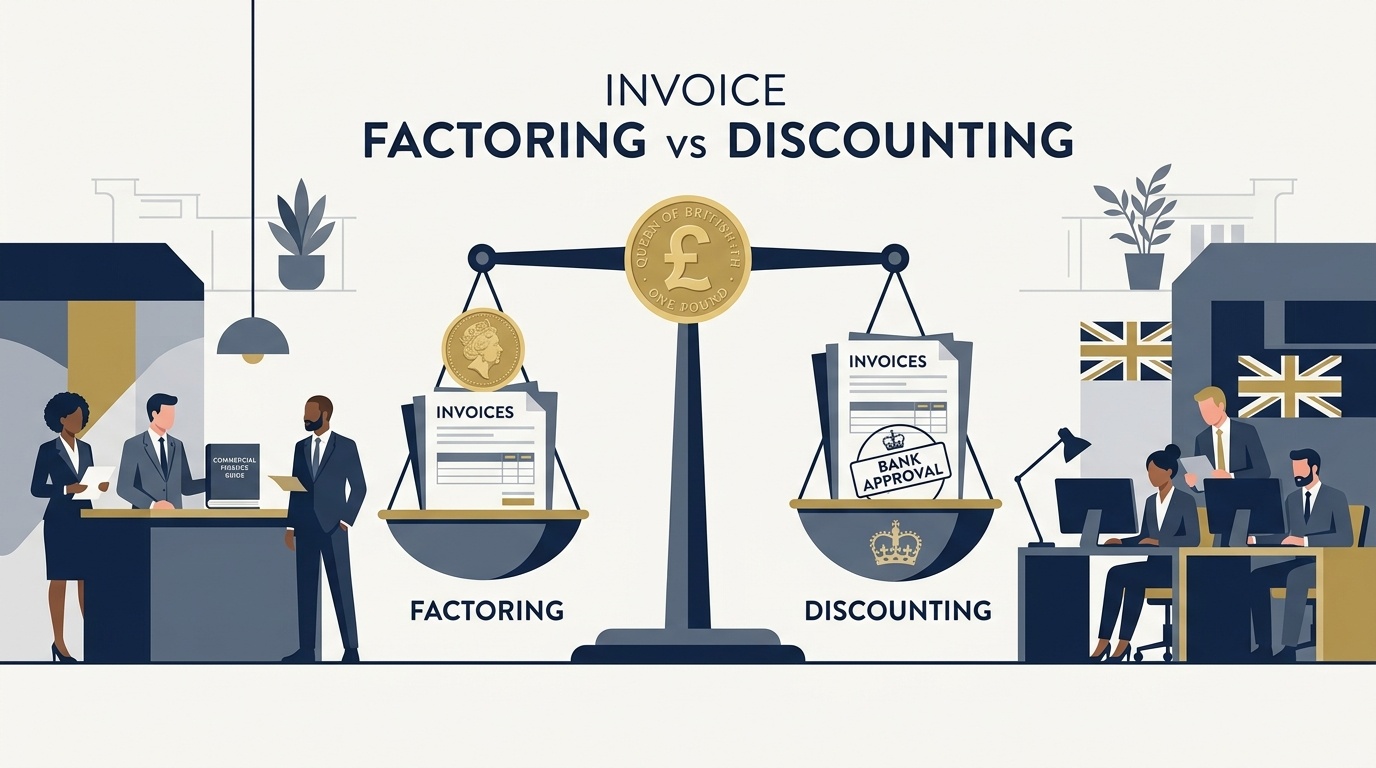
The primary difference between invoice factoring and invoice discounting lies in credit control management and confidentiality. Under invoice factoring, the lender advances up to 90% of your invoice value, takes over your sales ledger, and collects payments directly from your clients, making the arrangement visible to customers. Under invoice discounting, your company retains full control of credit collections, keeps the financing facility completely confidential from clients, and receives cash advances against unpaid invoices. Invoice discounting accounts for approximately 85% of total UK invoice finance turnover, whereas factoring suits smaller firms or businesses seeking outsourced credit management.
Key Takeaways
- UK Finance data confirms that UK invoice finance providers maintain over £20 billion in funding to supported businesses, processing £150 billion in annual volume.
- Invoice discounting accounts for 85% of the UK commercial debtor finance market due to its confidential nature and lower service fees.
- Factoring combines funding with credit management, relieving small management teams of invoice collection duties.
- Total costs combine a service fee (0.2% to 2.5% of turnover) and a discount margin (1.5% to 4.5% above bank base rates).
According to commercial lending data published by UK Finance, asset-based lending and invoice finance providers maintain over £20 billion in working capital across 40,000 UK client businesses at any given time. Together, these facilities support more than £150 billion in annual commercial turnover.
For growing UK small and medium enterprises selling to business clients on 30, 60, or 90-day payment terms, waiting for invoice settlement creates a persistent working capital gap. Outstanding invoices lock up cash that is required for payroll, supplier payments, and operational growth.
Invoice finance bridges this liquidity gap by releasing cash tied up in unpaid customer invoices before your clients settle their accounts. However, business owners face a critical choice between two main debt finance structures: invoice factoring and invoice discounting.
This guide provides a detailed breakdown of how both facilities work in 2026, comparing costs, credit management rules, confidentiality, and risk factors to help you select the right option for your company.
1. What Is Invoice Finance and How Does It Work?
Invoice finance is a commercial funding arrangement where a financial provider advances cash secured against a business’s accounts receivable (outstanding customer invoices).
Instead of waiting weeks for a customer to pay, your business receives an immediate cash advance—typically 70% to 90% of the gross invoice value—within 24 to 48 hours of issuing the invoice. Once the customer settles the invoice in full, the lender releases the remaining balance of 10% to 30%, minus agreed-upon lender fees.
1. Issue Invoice to Client ──► 2. Send Copy to Lender
│
4. Lender Releases Balance ◄── 3. Receive 80-90% Advance
(Minus Service Fees) (Within 24 Hours)
Unlike a traditional bank loan or overdraft, an invoice facility scales automatically with your trading volume. As sales increase, your available borrowing capacity grows in direct proportion to your invoice ledger.
For additional strategies on managing working capital, review our practical guide on cash flow tips.
2. What Is Invoice Factoring?
Invoice factoring is a combined funding and credit management facility designed for small businesses that prefer to outsource customer collections.
Under a factoring agreement, the lender (the factor) purchases your invoice ledger. The factoring company assumes responsibility for chasing customer payments, managing your sales ledger, and processing invoice payments directly into a dedicated bank account.
How Factoring Operates Step-by-Step:
1. Invoice Issuance: You deliver goods or services to your business customer and issue an invoice with 30 to 90-day payment terms.
2. Initial Cash Advance: You submit the invoice details to the factoring provider, who transfers up to 90% of the invoice value into your bank account within one working day.
3. Credit Management & Collection: The factoring provider’s credit control team handles payment collection, sending statements and contacting your clients directly.
4. Final Settlement: Your client pays the factoring company directly. The lender deducts their service fee and interest charges, transferring the remaining balance to your account.
Primary Advantage of Factoring:
Factoring provides dedicated credit control expertise. For small teams without an in-house credit manager, outsourcing collections saves administrative time and reduces bad debt exposure.
Primary Disadvantage of Factoring:
Factoring is non-confidential. Your clients are notified that a factoring company manages your invoices and pay the lender directly. Some corporate buyers view factoring as a sign of financial tightness, although acceptance has grown significantly across UK supply chains.
3. What Is Invoice Discounting?
Invoice discounting is an advance funding facility where your company maintains full, confidential control of your sales ledger and client collections.
According to UK Finance research, invoice discounting represents approximately 85% of total UK invoice finance turnover. It is favored by established businesses that possess dedicated internal credit control teams and wish to keep their financing arrangements hidden from customers.
INVOICE FACTORING INVOICE DISCOUNTING
├── Lender advances 80-90% ├── Lender advances 80-90%
├── Lender manages credit control ├── YOU manage credit control
├── Clients pay Lender directly ├── Clients pay your account
└── Non-Confidential └── 100% Confidential
How Invoice Discounting Operates Step-by-Step:
1. Invoice Issuance: You issue invoices to customers as normal, featuring your standard business bank details.
2. Facility Drawdown: You upload your invoice ledger data to the discounting provider’s platform and draw down up to 90% of the value.
3. Internal Collection: Your credit control team chases and collects customer payments exactly as usual. Customers remain unaware of the discounting facility.
4. Trust Account Payment: Customers pay into a trust bank account held in your company’s name. Once payments clear, the lender recovers their advance and fees, releasing the remaining funds.
4. Key Differences: Factoring vs Invoice Discounting
Comparing the two facilities highlights key differences in control, privacy, eligibility, and overall costs:
| Operational Feature | Invoice Factoring | Invoice Discounting |
|---|---|---|
| Credit Control | Managed by lender | Managed by your internal team |
| Confidentiality | Disclosed (customers know) | Confidential (hidden from customers) |
| Customer Contact | Lender contacts clients directly | You handle all customer communication |
| Typical Target Business | Startups & SMEs (£100k – £500k turnover) | Established firms (£500k+ turnover) |
| Service Fee Range | 0.75% to 2.5% of turnover | 0.2% to 1.0% of turnover |
| Discounting Rate | 1.5% to 4.5% over base rate | 1.5% to 3.5% over base rate |
| Bad Debt Protection | Available (Recourse or Non-Recourse) | Available (Recourse or Non-Recourse) |
5. Understanding the Costs: Fees Breakdown
Invoice finance pricing consists of two primary cost elements:
1. Service Fee (Administration Fee)
The service fee covers administrative setup, credit checks, ledger management, and software integration.
- Factoring Service Fee: Ranges from 0.75% to 2.5% of annual turnover, reflecting the credit control labor provided by the lender.
- Discounting Service Fee: Ranges from 0.2% to 1.0% of annual turnover, as the lender performs no collection work.
2. Discount Fee (Interest Margin)
The discount fee functions like bank overdraft interest. It is calculated daily on the net cash advanced to your business.
- Rate Range: Typically 1.5% to 4.5% above the Bank of England base rate.
Numerical Cost Example:
A company drawing £100,000 against invoices for 30 days under an invoice discounting facility:
- Service Fee (0.5% on £100,000 turnover): £500
- Discount Rate (4% per annum over 30 days): (£100,000 × 4% × 30 / 365) = £328.76
- Total Facility Cost for Month: £828.76
When planning company profit extractions and director pay alongside financing costs, evaluate your net margins carefully. You can calculate your director pay efficiency using our salary vs dividend split guide.
6. Recourse vs Non-Recourse Facility Types
Both factoring and discounting options are offered under two distinct risk structures:
Recourse Invoice Finance
Under recourse financing, your business retains full responsibility for bad debts. If a customer fails to pay an invoice within an agreed timeframe (typically 90 days), the lender reclaims the advance from your company or deducts it from future drawdowns. Recourse facilities carry lower service fees.
Non-Recourse Invoice Finance
Under non-recourse financing, the lender includes credit insurance against customer insolvency. If a client becomes formally insolvent, the lender absorbs the loss. Non-recourse facilities carry higher service fees and require strict credit limit approvals per client.
For businesses evaluating alternative commercial capital options, view our analysis of startup funding sources.
7. How to Choose the Right Facility for Your Business
To determine whether factoring or discounting fits your business, answer these four strategic questions:
Do you have an in-house credit control team?
│
├── YES ──► Choose INVOICE DISCOUNTING (Confidential, lower cost)
└── NO ──► Do you want to outsource customer collections?
│
├── YES ──► Choose INVOICE FACTORING (Credit management included)
└── NO ──► Consider Selective / Spot Invoice Discounting
Choose Invoice Factoring if:
- Your annual turnover is under £500,000.
- You lack dedicated credit control staff and waste management time chasing late payments.
- Your industry commonly uses factoring (e.g., recruitment, transport, haulage, manufacturing).
Choose Invoice Discounting if:
- Your annual turnover exceeds £500,000.
- You possess strong, established internal credit control systems.
- You require absolute confidentiality to protect existing client relationships.
8. Frequently Asked Questions
Will invoice discounting affect my company’s credit rating?
No. An invoice discounting facility is an asset-backed commercial arrangement, not an uncollateralised debt burden. Lenders view secured debtor facilities favorably when backed by strong customer accounts.
Can I select specific invoices to finance instead of my entire ledger?
Yes. Known as Selective Invoice Finance or Spot Factoring, this option allows you to finance single high-value invoices rather than committing your whole sales ledger to a long-term contract.
What turnover is required for invoice discounting in the UK?
Most UK commercial lenders require a minimum annual turnover of £250,000 to £500,000 for confidential invoice discounting, although digital fintech lenders now offer lower thresholds for growing firms.
Are invoice finance fees tax-deductible?
Yes. Both service fees and discount charges are deductible business expenses for UK Corporation Tax purposes.
Your Next Actions
1. Audit Your Debtor Book: Calculate your average Days Sales Outstanding (DSO) and total cash currently locked in unpaid customer invoices.
2. Review Internal Credit Capabilities: Determine whether your team has capacity for internal collections (pointing to discounting) or needs external credit control (pointing to factoring).
3. Compare Market Quotes: Obtain at least three independent quotes comparing service fees, discount rates, and contract termination terms.
4. Model Your Cash Flow: Utilize our interactive financial tools in the Business Tools Hub to project working capital requirements before signing a facility agreement.
Editorial Team & Signature
Written by Oliver Carpenter, Lead Commercial Finance Analyst at Elite Business Journal. Published February 2026.