Executive Brief: Traditional search engine optimization is experiencing its largest disruption in twenty-five years. Leading technology analysts at Gartner Research project that traditional search engine query volume will drop by 25 percent as consumers and enterprise decision-makers migrate to conversational artificial intelligence answer engines like ChatGPT, Google Gemini, Perplexity, and Claude. In this new Generative Engine Optimization (GEO) paradigm, BrandRank.AI normalization transformation rules have become essential for brands seeking to protect their digital market share, eliminate hallucinated product attributes, and secure consistent recommendations across large language models.
Quick Answer: What Are BrandRank.AI Normalization Transformation Rules?
BrandRank.AI normalization transformation rules refer to the algorithmic and data-cleaning methods used to standardize inconsistent, fragmented enterprise brand signals across generative AI platforms. Because large language models (LLMs) ingest unstructured data from across the web, variations in brand spelling (such as “BrandRank.AI”, “BrandRank AI”, and “brandrank.ai”), conflicting product specifications, and disjointed review metrics often cause entity dilution or inaccurate AI citations.
These rules function through a four-part pipeline: entity resolution (mapping all brand variants to a single canonical knowledge graph ID), attribute standardization (structuring features and pricing for retrieval-augmented generation), sentiment calibration (normalizing model response scores across varying prompt temperatures), and authoritative grounding (aligning external citations with structured Schema.org data). Implementing these transformation rules ensures that AI answer engines accurately recognize, cite, and recommend an enterprise brand.
Key Takeaways for Enterprise Brand Leaders
- Entity Dilution Risk: Inconsistent brand names, fragmented review profiles, and contradictory web data dilute an organization’s authority score within LLM vector embeddings.
- Canonical Mapping: Normalization transformation rules map disparate digital references into a single verified entity ID recognized across major AI answer engines.
- Attribute Protection: Standardizing product specifications, enterprise pricing, and compliance certifications prevents AI models from hallucinating false terms or outdated features.
- Sentiment Normalization: Calibrating brand share of voice requires testing prompt responses across varied temperature settings and conversational contexts.
- Structured Data Integration: Enforcing strict Schema.org Brand and Organization markup establishes direct grounding signals for retrieval-augmented generation (RAG) crawlers.
The Shift from SEO to GEO: Why AI Brand Normalization Matters
For more than two decades, digital brand visibility was governed by predictable search engine algorithms. Marketers optimized metadata, published keyword-targeted articles, and acquired backlinks to win ten blue links on Google. Today, enterprise buyers, B2B procurement officers, and everyday consumers bypass traditional search result pages entirely, asking generative artificial intelligence engines to evaluate software, suggest vendors, and compare products.
However, generative models do not store or retrieve web pages like traditional search engines. They process information through mathematical vector embeddings, probabilistic token generation, and real-time retrieval-augmented generation (RAG) pipelines. When a user asks an AI model, “Which enterprise cybersecurity platform provides the best SOC-2 compliance automation?”, the model does not run a simple keyword match. It queries its internal weights, searches grounding indices, and synthesizes a recommendation based on its understanding of brand entities.
If an enterprise has fragmented branding across its website, Wikipedia, review portals, and press releases, the AI model struggles to resolve the entity. The brand’s authority score becomes diluted across multiple disconnected nodes. In the worst scenarios, the AI engine hallucinates nonexistent limitations, conflates the company with a competitor, or omits the organization completely from buying shortlists. Integrating BrandRank.AI normalization transformation rules into your broader digital marketing framework is the foundation for safeguarding enterprise share of voice in the generative era.
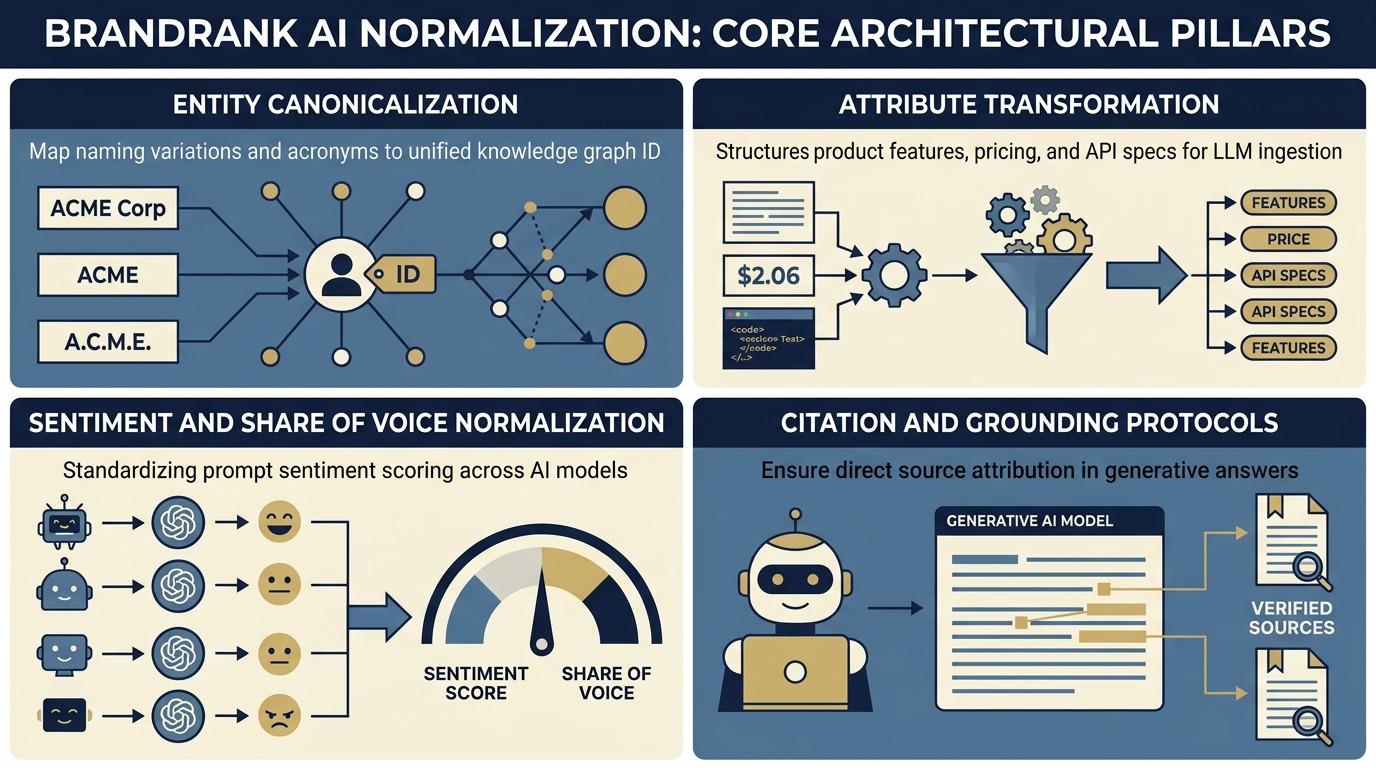
The Four Architectural Pillars of AI Brand Data Normalization
The BrandRank.AI normalization framework establishes systematic data engineering standards to clean, unify, and transform brand signals into machine-readable knowledge graph assets. This methodology rests on four foundational pillars:
1. Entity Resolution and Canonical Naming Rules
Modern enterprises accumulate vast digital footprints over time. Mergers, rebranding initiatives, product spin-offs, and international domain variations create inconsistent brand references. An enterprise might appear as “BrandRank.AI”, “BrandRank AI”, “BrandRank Inc.”, or “brandrank.ai” across public databases, business registries, and software directories.
Entity resolution rules ingest these disparate textual representations and map them to a single canonical entity identifier. This process involves:
- Lexical and Orthographic Normalization: Stripping punctuation variations, capitalizations, top-level domain extensions (.ai, .com, .io), and legal suffixes (LLC, Inc., Corp.) to identify core trademark roots.
- Knowledge Base Linking: Binding the canonical entity to external authoritative knowledge repositories, including Wikidata, Google Knowledge Graph Machine IDs (MIDs), and Crunchbase entities.
- SameAs Relationship Encodings: Generating unambiguous structured mappings that explicitly inform web crawlers that multiple digital channels belong to the exact same organization.
2. Attribute and Specification Transformation
One of the most dangerous risks facing brands in the AI search environment is hallucination. When an AI answer engine synthesizes technical capabilities, subscription costs, or compliance standards from outdated third-party blog posts, it can present inaccurate information to prospective enterprise buyers.
Attribute transformation rules convert unstructured prose into standardized, machine-verifiable tabular data. By structuring pricing tiers, API limits, security frameworks (SOC 2, ISO 27001, HIPAA), and supported operating systems into standardized semantic schemas, brands provide grounding models with verified facts that override probabilistic speculation.
3. Sentiment and Share of Voice (SOV) Normalization
Evaluating how an artificial intelligence platform perceives your brand requires more than running a single search prompt. Large language models are non-deterministic; their outputs fluctuate depending on conversational history, user personas, model temperature settings, and prompt phrasing.
BrandRank.AI normalizes brand sentiment by running structured, multi-prompt test batteries across hundreds of synthetic buyer queries. Transformation algorithms calibrate sentiment polarity, recommendation frequency, and positional prominence across multiple competing models (such as GPT-4o, Claude 3.5 Sonnet, Gemini 1.5 Pro, and Perplexity Pro). This statistical normalization produces an objective Brand Visibility Index that accounts for model variance and temperature shifts.
4. Citation and Grounding Protocols
In modern Retrieval-Augmented Generation architectures, the model performs real-time web retrieval to substantiate its answers with clickable citations. If your brand documentation is buried inside unstructured PDFs, unindexed JavaScript files, or gated whitepapers, RAG search bots cannot extract direct citation passages.
Citation transformation rules restructure brand content into citable semantic units (typically 150 to 250 words) featuring clear contextual subheadings, direct factual declarations, and structured data markup, making it easy for AI crawlers to quote your official pages directly.
| Transformation Component | Unnormalized Input (Raw Web Data) | Normalized Output (GEO Asset) | Primary Impact on AI Answer Engines |
|---|---|---|---|
| Brand Identity | BrandRank, BrandRank AI, brandrank.ai, Brand Rank | Canonical Entity URI with Schema.org SameAs mapping | Consolidates authority scores; prevents entity dilution |
| Pricing Data | Outdated blog mentions: “Starts around $499/mo” | Structured PriceSpecification schema with effective dates | Eliminates AI pricing hallucinations and misleading quotes |
| Product Capabilities | Vague marketing copy: “Industry-leading scalability” | Quantified tabular specifications and API rate metrics | Enables accurate AI comparison tables against competitors |
| Sentiment Polarity | Single isolated prompt answer: “Neutral/Cautionary” | Aggregated multi-temperature index score (0 to 100) | Provides statistically valid executive brand monitoring |
| Trust & Governance | Unverified third-party software review snippets | Authoritative source citations meeting AI safety standards | Boosts inclusion probability in AI Overview answer boxes |
Step-by-Step Implementation: The Enterprise AI Normalization Process
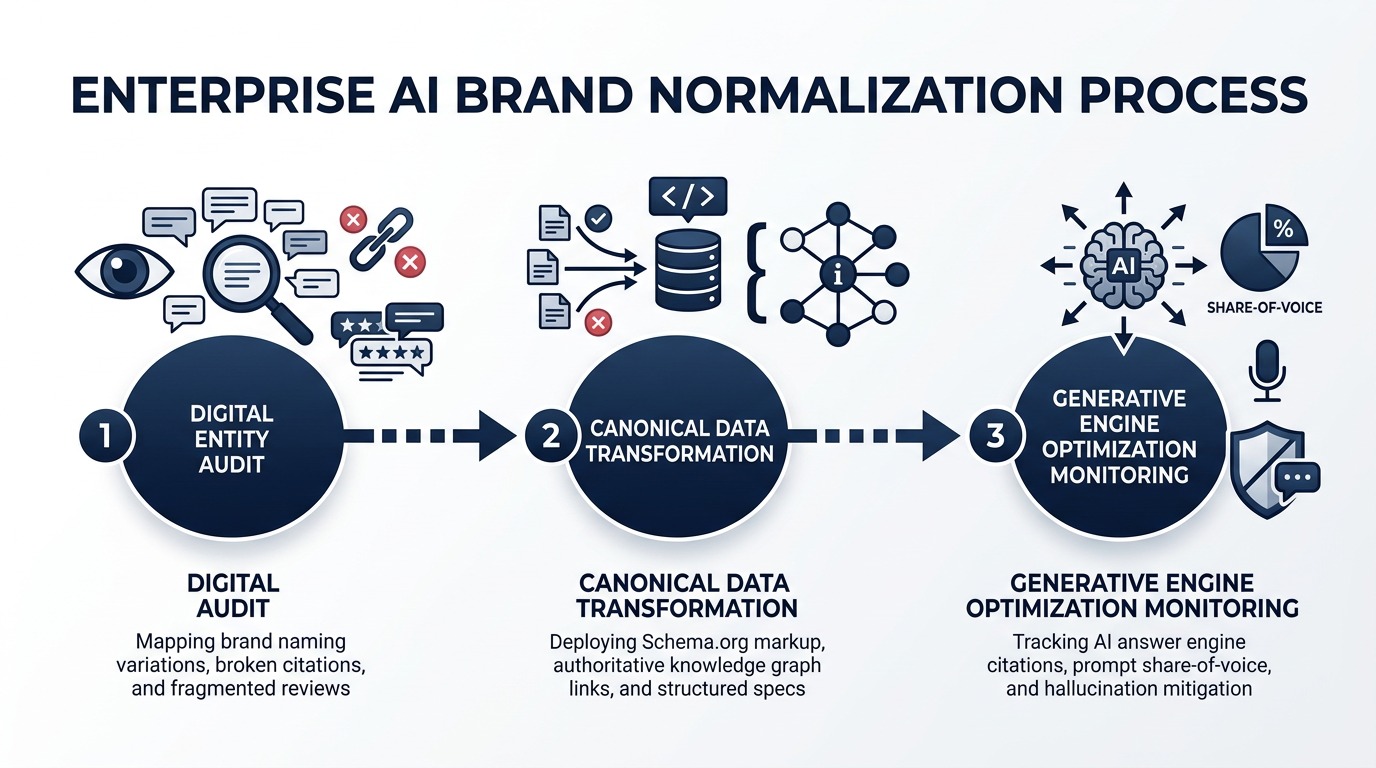
Executing an effective brand data transformation requires coordination between corporate marketing, data engineering, and technical SEO teams. Enterprises should follow a structured three-stage deployment protocol:
Stage 1: Digital Entity Audit and Footprint Discovery
The first phase maps every public data point associated with your organization across the digital ecosystem. This audit identifies naming conflicts, outdated specifications, and misattributed reviews across four critical zones:
- Owned Digital Properties: Review corporate websites, knowledge bases, press release archives, and documentation portals to catalog all variations of product names, executive rosters, and corporate entity declarations.
- Third-Party Business Directories: Audit major industry review hubs (such as G2, Trustpilot, Capterra, and Crunchbase) to identify inconsistent business descriptions, old logos, and broken website links.
- Public Knowledge Repositories: Inspect Wikipedia pages, Wikidata entries, and Google Knowledge Panels to verify that your organization’s legal name, founding date, headquarters, and parent company relationships are accurate.
- Generative Baseline Benchmarking: Query leading AI answer engines (ChatGPT, Perplexity, Gemini, Claude) with realistic enterprise purchase prompts to identify current hallucination patterns and citation frequencies.
Tracking these digital assets is essential for protecting your corporate identity and executing a modern online reputation management strategy.
Stage 2: Canonical Data Transformation and Schema Deployment
Once data discrepancies are cataloged, technical teams implement transformation rules that structure information for easy consumption by artificial intelligence search crawlers:
- Deploy Advanced Schema.org Entity Markup: Implement rich JSON-LD markup on your homepage, about page, and core product pages. Utilize Schema.org Brand Standards and Organization schemas with explicit `sameAs` arrays linking directly to verified social profiles, Wikidata items, and corporate registries.
- Construct Semantic Specification Tables: Convert complex technical descriptions into high-contrast, clean HTML tables. Avoid embedding critical product specifications inside flattened images or complex JavaScript accordion tabs that AI scrapers often ignore.
- Publish a Machine-Readable Fact Sheet: Create a dedicated, publicly accessible facts page (such as `/brand-facts/` or `/press-kit/`) detailing official corporate naming conventions, authorized executive bios, product version histories, and direct media contact channels.
- Align with AI Governance Frameworks: Ensure that corporate data declarations adhere to recognized principles established in the NIST AI Risk Management Framework, which emphasizes data accuracy, transparency, and traceability in automated systems.
Stage 3: Generative Engine Optimization (GEO) Monitoring
AI brand optimization is not a one-time project; it requires ongoing monitoring and refinement. Large language models continuously update their weights, fine-tuning datasets, and retrieval indexes. An ongoing monitoring protocol includes:
- Prompt Share of Voice (SOV) Tracking: Run weekly automated prompt sweeps across key commercial buyer queries to track how often your brand appears in top recommendations compared to direct industry rivals.
- Hallucination Detection and Mitigation: Monitor AI responses for erroneous claims regarding pricing, discontinued features, or false security compliance claims. When hallucinations are detected, identify the corrupted web sources feeding the RAG pipeline and execute digital PR updates to displace the inaccurate data.
- Direct Audience Channel Integration: Balance AI discovery with owned communications by driving interested readers directly into direct audience engagement channels, ensuring that your enterprise maintains permanent customer relationships regardless of third-party platform algorithm updates.
The Data Engineering Stack for AI Entity Normalization
Enterprise data teams do not manage entity resolution manually; they deploy specialized data pipelines to automate entity extraction and verification across millions of documents. A standard enterprise GEO data pipeline incorporates four core technical components:
1. Named Entity Recognition (NER) and Disambiguation
Using open-source natural language processing libraries (such as spaCy, Hugging Face Transformers, or Stanford CoreNLP), data engineers scan public web mentions, social forums, and news archives. Custom NER models are trained to extract brand entities, executive quotes, and product models, tagging each mention with a probabilistic confidence score.
2. Graph Databases and Semantic Triples
Extracted entities are stored in enterprise graph databases such as Neo4j, Amazon Neptune, or Ontotext GraphDB. Relationships between entities are expressed as semantic triples (Subject-Predicate-Object), such as `[BrandRank.AI] -> [offersProduct] -> [AI Visibility Intelligence]`. Graph databases enable rapid querying of entity connections, allowing marketing engineers to detect conflicting attribute declarations before they propagate into external RAG retrieval indices.
3. Automated Prompt Regression Testing
To measure the impact of normalization updates, engineering teams build automated testing harnesses using frameworks like LangChain, LlamaIndex, or custom Python scripts. These harnesses fire hundreds of standardized commercial prompts against model APIs on a recurring schedule, logging output sentiment, citation links, and competitor co-mentions into analytical data warehouses for executive reporting.
| Metric Category | Traditional SEO Measurement | Generative Engine Optimization (GEO) Metric |
|---|---|---|
| Visibility & Reach | Keyword Ranking Position (1 to 10) | Prompt Recommendation Share of Voice (% inclusion) |
| Traffic Attribution | Organic Click-Through Rate (CTR) | RAG In-Text Citation Frequency and Source Attribution |
| Brand Perception | Star Ratings on Review Aggregators | Normalized Sentiment Polarity Score in Generated Prose |
| Data Accuracy | Meta Title and Description Display | Hallucination Rate on Pricing and Product Attributes |
Common Pitfalls in AI Brand Data Management
As marketing teams rush to adapt to generative search engines, many fall into common traps that undermine their brand visibility:
1. Over-Optimizing for Traditional Keywords While Ignoring Entities
Traditional SEO teams often attempt to optimize for AI engines by stuffing keywords into blog articles. Large language models operate on entity understanding and semantic relationships, not keyword density. Focusing on keyword counts rather than establishing clear entity definitions inside knowledge graphs yields minimal results in AI answer generation.
2. Neglecting Third-Party Grounding Sources
Many brands assume that maintaining clean data on their corporate website is sufficient. However, modern retrieval-augmented generation systems place high trust weights on independent, third-party sources. If your company website states that your software is HIPAA compliant, but major industry review directories and news articles do not mention this certification, the AI model may refuse to cite the capability.
3. Ignoring Model Variance and Temperature Sensitivity
Testing a brand query once on ChatGPT and assuming the answer represents all users is a critical mistake. Temperature settings, user geographic location, conversational context, and model versions (e.g. GPT-4o versus o1) dramatically alter responses. Enterprise tracking requires normalized, multi-variable prompt testing.
Frequently Asked Questions About BrandRank.AI and AI Normalization
What is the primary difference between SEO and Generative Engine Optimization (GEO)?
Search engine optimization focuses on ranking specific web URLs within traditional search result indexes through keywords, backlinks, and on-page metadata. Generative Engine Optimization focuses on ensuring an enterprise entity is understood, accurately cited, and recommended within conversational AI answer engines.
Why do artificial intelligence models hallucinate brand information?
AI models hallucinate when their training data contains conflicting, outdated, or sparse information about an entity.
How long does it take for AI brand normalization changes to take effect?
For AI answer engines using real-time retrieval-augmented generation (like Perplexity and Google Gemini AI Overviews), structured data updates can influence citations within days or weeks. For underlying foundation model training weights, updates occur during subsequent model retraining cycles, which typically happen over several months.
Does Schema.org structured data directly influence AI answer engines?
Yes. Real-time RAG web crawlers heavily prioritize structured semantic data, including Schema.org Brand and Organization markup, because it provides clear, machine-readable facts that can be ingested with high confidence and minimal token processing overhead.
Securing Enterprise Brand Identity in the AI Era
The shift from traditional search engines to conversational artificial intelligence represents a permanent change in how people access and consume information. Brands that allow their digital footprint to remain fragmented will find themselves systematically erased from AI-generated recommendations and buying guides. By applying BrandRank.AI normalization transformation rules, organizations unify their digital identity, protect their commercial attributes from hallucination, and secure their standing as authoritative industry leaders in the generative era.