According to annual payment statistics published by UK Finance in its UK Payment Markets Report, British businesses deploy commercial credit and charge cards for over £70 billion in annual transaction volume, managing more than 3.5 million active commercial card accounts. With average business-to-business credit terms stretching up to 60 days, commercial cards provide companies with an agile liquidity buffer, granting up to 56 days of interest-free credit on daily operational expenses. For founders and finance directors, commercial cards have evolved from simple travel expense tools into integral working capital facilities.
However, securing a business credit card uk facility requires a clear understanding of commercial credit regulations. Many business directors mistakenly assume that business cards carry the same statutory consumer protections as personal credit cards, particularly Section 75 purchase refund guarantees. In reality, business credit agreements operate under separate legal standards, leaving company directors personally liable under director guarantees while offering zero statutory Section 75 coverage. This guide provides a thorough operational analysis of UK commercial credit cards, comparing fee models, legal liabilities, reward structures, and digital accounting integrations.
Quick Answer: How Do Business Credit Cards Work in the UK?
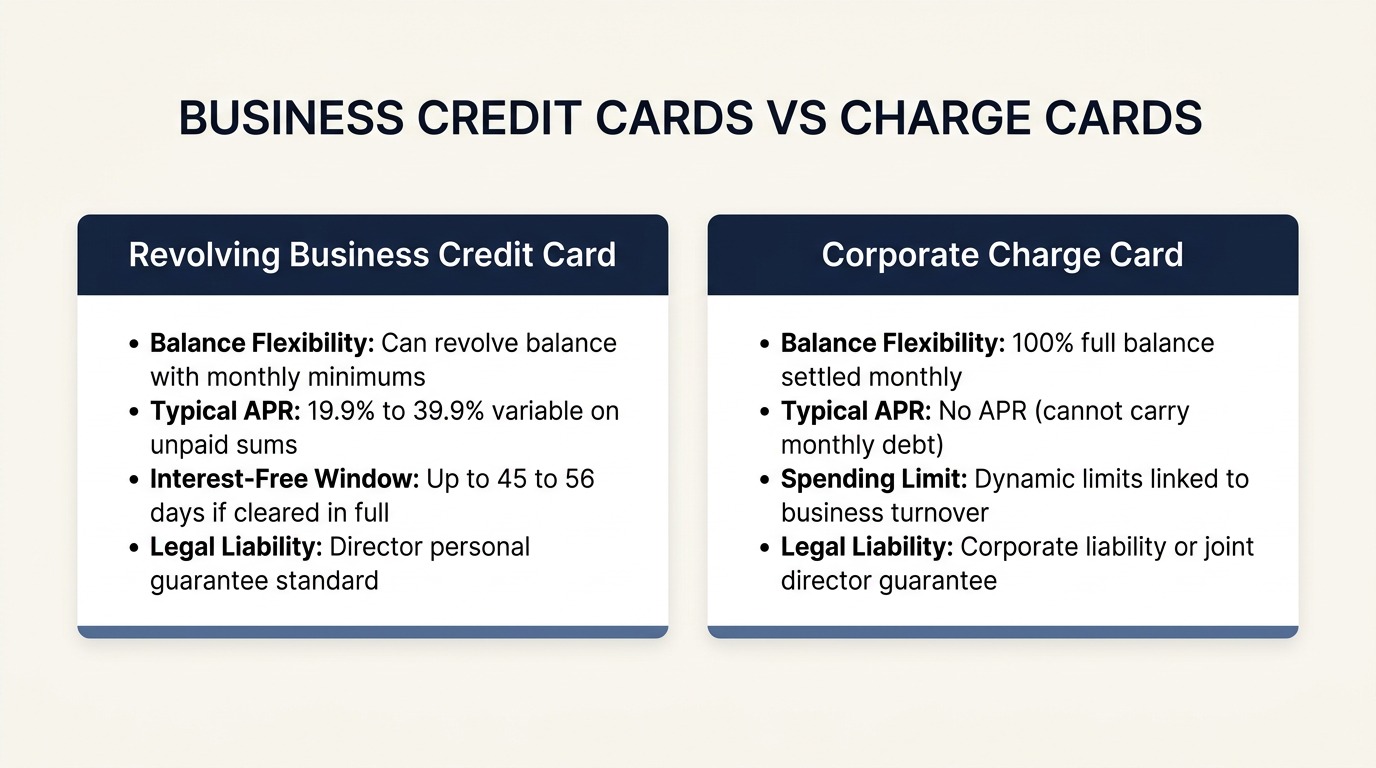
A UK business credit card is a revolving commercial credit facility issued to a limited company, partnership, or sole trader to fund business expenditures. Cardholders receive between 30 and 56 days of interest-free credit, provided the balance is cleared in full by the monthly statement due date. Representative APRs typically range from 19.9% to 39.9% variable if balances are rolled over. Unlike personal credit cards, business credit cards issued to limited companies are not covered by Section 75 of the Consumer Credit Act 1974, though buyers can utilize card network Chargeback schemes to dispute transactions. Most providers require a personal guarantee from company directors, holding them personally liable for unpaid balances if the business defaults.
Key Takeaways for UK Business Owners
- Business credit cards provide up to 56 interest-free days on operational purchases when settled in full each month.
- Section 75 statutory refund protection does not apply to corporate business cards or limited company accounts.
- Card issuers typically require a director’s personal guarantee, creating individual liability upon corporate default.
- Revolving cards permit minimum monthly payments at 19.9% to 39.9% APR, whereas charge cards require 100% balance settlement.
- Direct API integrations with cloud platforms like Xero and QuickBooks automate expense reconciliation and VAT audits.
What Is a Business Credit Card and How Does It Function?
A business credit card functions as an unsecured, revolving commercial line of credit assigned to an enterprise. Issued under corporate payment networks like Visa, Mastercard, or American Express, these cards enable directors and authorized staff members to settle corporate travel, software subscriptions, supplier invoices, and emergency operational costs.
The primary commercial benefit of a business card is cash flow optimization. When an enterprise executes an expenditure on day one of a 30-day billing cycle, the statement arrives at month end with a further 25-day settlement window. If the balance is paid in full before this deadline, the business effectively enjoys up to 56 days of zero-interest working capital. This short-term financing allows businesses to bridge receivables delays without drawing on expensive overdraft facilities or liquid cash reserves.
Modern commercial card platforms have evolved far beyond simple physical plastic. Contemporary UK business card providers issue unlimited virtual cards with custom spend limits, automated merchant restrictions, and instant digital receipt capture, fundamentally changing how corporate expense policies are enforced.
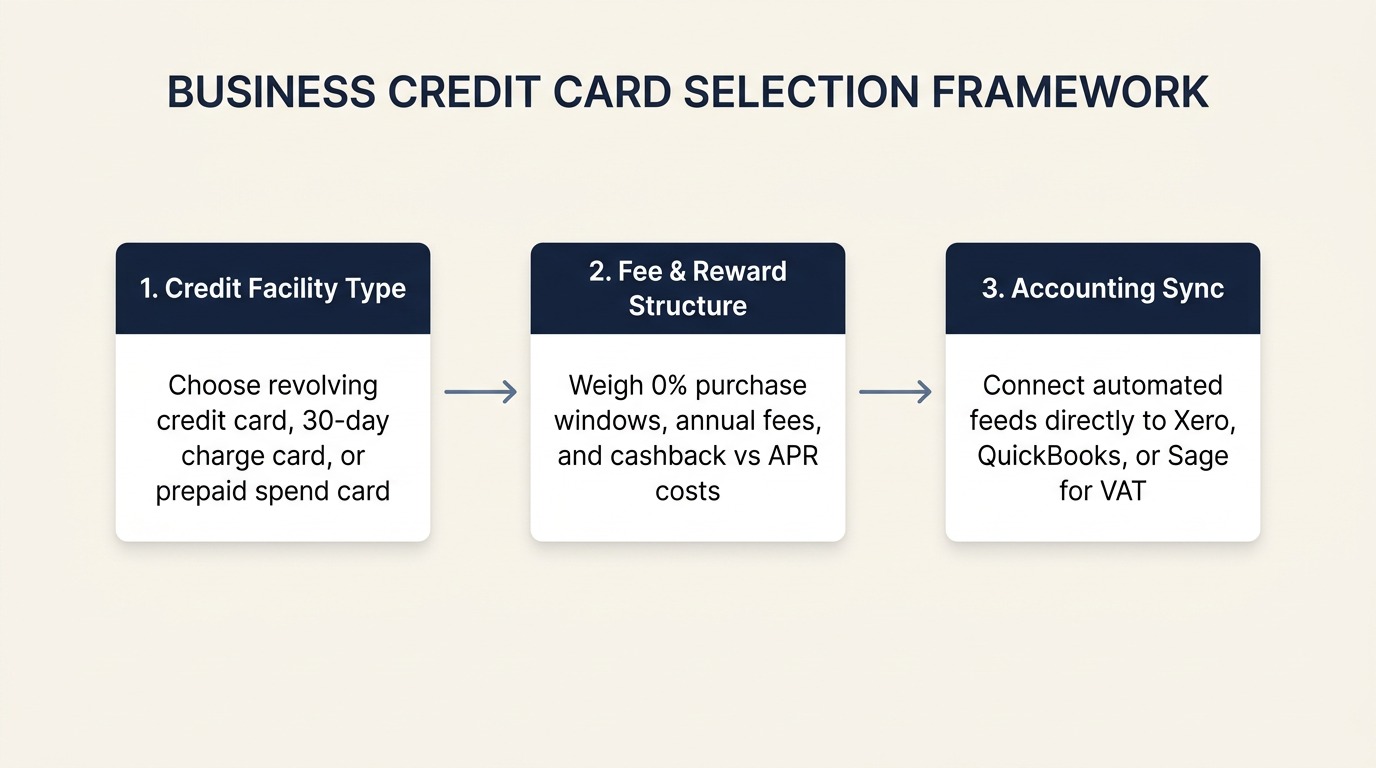
The Business Credit Card Selection Framework
Selecting the right commercial card product depends on your company’s cash flow discipline, spending velocity, and accounting requirements.
1. Revolving Business Credit Cards
Revolving business credit cards represent the most common card structure. The provider assigns an approved credit limit (for example, £20,000). At the end of each billing cycle, the company can choose to clear the entire statement balance or make a minimum contractual payment (typically 2% to 3% of the outstanding balance or £25). If a balance is rolled over, interest accrues at the variable annual percentage rate (APR), usually ranging between 19.9% and 35.9%.
While revolving cards provide flexibility during temporary revenue dips, carrying revolving debt is an expensive method of long-term funding. Companies should treat revolving balances as emergency liquidity rather than sustained capital.
2. Corporate Charge Cards
Popularized by institutions like American Express, corporate charge cards do not feature a revolving credit facility. Instead, the cardholder is contractually required to settle 100% of the statement balance in full every single month. Because the debt cannot roll over, charge cards do not carry an APR. Instead, providers charge an annual card membership fee ranging from £150 to £650.
Charge cards often offer higher, dynamic spending limits that adjust automatically in line with your historical business cash flow, seasonal revenues, and payment record. They represent an excellent choice for businesses with predictable cash reserves that want generous rewards and travel perks without the risk of accumulating compounding debt.
3. Spend Management and Smart Corporate Cards
Fintech providers such as Pleo, Soldo, and Capital on Tap have pioneered smart corporate expense cards. These platforms combine flexible credit limits or pre-funded balances with dedicated spend management software. Finance managers can issue dedicated physical or virtual cards to employees with pre-set daily or monthly allowances.
Whenever an employee buys an item, a mobile push notification prompts them to photograph the receipt. The platform automatically extracts the supplier name, invoice amount, and VAT breakdown using optical character recognition, eliminating manual expense claims and lost receipts.
Legal Reality: Section 75 vs Chargeback & Director Guarantees
One of the most critical legal distinctions in UK commercial banking separates consumer credit cards from business credit cards. Company directors who fail to recognize these differences can face unexpected legal and financial exposures.
The Section 75 Exclusion
Under Section 75 of the Consumer Credit Act 1974, consumer credit card issuers are held jointly and severally liable with merchants if purchased goods or services (valued between £100 and £30,000) are faulty, undelivered, or misdescribed. If a consumer buys flight tickets or office equipment and the vendor collapses into administration, the credit card company must issue a full refund.
Crucially, Section 75 does not apply to business credit cards issued to limited companies, LLPs, or large partnerships. Under UK statute, commercial entities are presumed to possess commercial negotiating experience, placing corporate transactions outside consumer credit safeguards. Sole traders borrowing under £25,000 may retain statutory protection under specific consumer credit definitions, but incorporated businesses enjoy zero Section 75 statutory recourse.
The Chargeback Alternative
Although Section 75 protection is absent, business cardholders can utilize card network Chargeback rules. Governed internally by Visa, Mastercard, and American Express, Chargeback allows the card issuer to claw back funds from the merchant’s acquiring bank if goods fail to arrive or transactions are proven fraudulent.
However, Chargeback is a contractual mechanism rather than a statutory right. Unlike Section 75, which allows legal claims against the card company directly, Chargeback is subject to strict time limits (typically 120 days from the transaction date) and can be disputed by the merchant.
Director Personal Guarantees and Liability
To mitigate risk, almost all UK business credit card providers demand a Director’s Personal Guarantee (PG) or joint liability agreement when issuing cards to small and mid-sized enterprises. If your limited company encounters insolvency or enters liquidation with an outstanding credit card balance of £15,000, the card provider will enforce the personal guarantee against your personal assets, savings, or private estate.
Directors should carefully inspect the card agreement to verify whether liability is purely corporate or backed by a personal guarantee. For high-growth businesses, transitioning to corporate liability cards once balance sheet maturity is reached removes personal director exposure.
Commercial Card Comparison: Fees, Rates and Rewards
The UK commercial card landscape features diverse products designed for distinct operational profiles. The comparative matrix below outlines key parameters across major commercial card categories.
According to UK Finance commercial payment data, commercial card interchange fees in the UK remain capped under statutory standards, allowing providers to compete primarily on software functionality, cashback programs, and automated accounting synchronization.
Expense Management and Cloud Accounting Integration
One of the primary reasons modern enterprises adopt business credit cards is the reduction in administrative accounting friction. Reconciling employee paper receipts at month end wastes valuable finance team hours.
1. Direct Cloud Bank Feeds
Modern commercial card providers connect directly with cloud accounting platforms such as Xero, QuickBooks Online, Sage, and FreeAgent via secure Open Banking APIs. Every transaction clears into your accounting ledger in real time, automatically tagged with merchant categories, transaction dates, and foreign exchange rates.
2. Automated Receipt Matching and VAT Categorization
When an employee uses their card, they capture a smartphone photograph of the paper receipt or tax invoice. Advanced optical character recognition (OCR) engines match the uploaded image to the corresponding bank transaction, extracting the supplier’s VAT registration number, gross amount, and VAT breakdown.
This automated audit trail provides HM Revenue & Customs (HMRC) compliant digital records, protecting your business from disallowed input VAT claims during corporate tax audits.
3. Granular Employee Spend Controls
Rather than sharing a single company card across multiple departments, finance managers can issue dedicated physical or virtual cards to individual staff members. Management can apply precise parameters to each card, including:
- Monthly, weekly, or single-transaction expenditure caps.
- Merchant Category Code (MCC) restrictions (for instance, enabling fuel and hotel purchases while blocking gambling, entertainment, or retail electronics).
- Instant freeze and unfreeze toggles managed through a centralized administrator dashboard.
For broader working capital strategies and operational cost control, review our analysis of cash flow management strategies.
Commercial Credit Scoring and Eligibility Criteria
Applying for a commercial credit card triggers assessments across both corporate and personal credit files.
1. Corporate Credit Reference Agencies
Commercial card issuers check corporate credit bureaus, including Experian Business, Creditsafe, and Dun & Bradstreet. Underwriters assess your company’s Companies House filing history, statutory accounts, trading age, and commercial payment performance (such as your Days Beyond Terms score). Maintaining an active, clean corporate credit profile increases your chances of securing higher borrowing limits without personal collateral.
2. Personal Director Credit History
For early-stage limited companies, startups, and small businesses with modest balance sheets, the underwriting decision relies heavily on the personal credit records of company directors. A soft credit search is typically performed during eligibility screening, followed by a hard search upon final application submission.
Any historical County Court Judgments (CCJs), individual voluntary arrangements (IVAs), or personal defaults on the director’s record will significantly restrict credit limits or lead to outright rejection. Maintaining clean personal finances is essential when managing early-stage corporate borrowing.
Guidance from the British Business Bank commercial credit advice emphasizes that responsible business credit card usage serves as an effective mechanism for newly incorporated limited companies to establish a strong corporate credit footprint, paving the way for larger facilities like commercial mortgages and asset finance.
Common Mistakes to Avoid with Commercial Cards
While business credit cards provide immense operational convenience, improper usage can cause severe accounting and legal complications.
1. Commingling Personal and Business Expenditures
Using a business credit card for personal shopping or using personal cards for corporate purchases creates major tax complications. In a limited company, personal purchases paid by the company are classified as a benefit-in-kind or create an overdrawn Director’s Loan Account (DLA). If not repaid within nine months of the company year-end, an overdrawn director’s loan triggers a Section 455 tax charge at 33.75% from HMRC.
2. Treating Cards as Long-Term Debt
Business credit cards are designed for 30-to-56-day transactional liquidity. Rolling over unpaid balances at 25% or 35% variable APR quickly erodes commercial margins. If your business requires multi-month funding to purchase bulk inventory or bridge lengthy receivables, structured debt like instant business loan options or invoice discounting facilities delivers substantially lower borrowing costs.
3. Ignoring Foreign Currency Transaction Fees
Many UK business owners pay for software tools, online advertising, and overseas supplies in US dollars or euros using standard high-street business cards. Traditional clearing banks charge foreign transaction fees of 2.75% to 2.99% on every international purchase. Over a year of major marketing spend, these fees silently drain thousands of pounds. Switching to specialized multi-currency or low-FX commercial cards eliminates foreign exchange surcharges.
4. Resolving Merchant Disputes Correctly
When commercial suppliers fail to deliver contracted goods, do not rely on passive chargeback claims. Document all communications, retain written delivery terms, and issue formal breach notices. If disputes with financial institutions or card providers cannot be resolved internally, consult the Financial Ombudsman Service small business dispute guidance to determine whether your enterprise meets the small business eligibility threshold for independent dispute resolution.
Frequently Asked Questions
Can a brand new limited company get a business credit card?
Yes, newly formed limited companies can obtain business credit cards. Because the company lacks an established trading track record, providers will underwrite the application based on the director’s personal credit score, requiring a director’s personal guarantee. Certain fintech providers also offer pre-funded or debit-based smart expense cards with zero credit checks.
Is a business credit card better than a business bank overdraft?
Both products serve distinct cash flow needs. A business credit card provides up to 56 days of interest-free credit on purchases and offers automated expense management and reward points. An overdraft provides cash liquidity to fund payroll, rent, and direct debits, but interest accrues immediately upon drawing funds without an interest-free window.
What happens if my business goes bust with credit card debt?
If your limited company enters liquidation and you signed a personal guarantee, the credit card provider will hold you personally liable for the full balance. If you did not sign a personal guarantee and the card was issued on pure corporate liability, the debt is treated as unsecured commercial debt and settled according to standard corporate insolvency priority.
Can sole traders use personal credit cards for business expenses?
While legally permitted, using a personal credit card for business expenses makes bookkeeping messy and complicates HMRC tax audits. A dedicated business credit card separates business transactions from private spending, simplifies bookkeeping, and protects your personal credit profile from business debt fluctuations.
Do business credit cards help build company credit scores?
Yes, provided the card issuer reports to UK commercial credit reference agencies like Experian Commercial and Creditsafe. Paying your balance in full each month and keeping credit utilization below 30% helps establish a strong corporate credit rating, improving approval odds for future commercial loans and equipment leases.
Are business credit card fees tax deductible in the UK?
Yes, annual card fees, interest charges, and foreign transaction costs incurred on business credit cards are allowable business expenses that can be deducted against trading profits to reduce your Corporation Tax liability.
The Bottom Line: How to Proceed
A business credit card serves as a practical financial instrument for UK commercial operators, providing short-term interest-free liquidity, streamlined expense administration, and valuable reward dividends. When utilized with discipline, commercial cards keep operating cash flow agile while automating accounting compliance.
However, credit cards must be deployed with clear operational boundaries. Avoid commingling personal and company spending, understand the legal extent of your director personal guarantee, and ensure revolving balances are cleared in full every month to avoid punitive compounding interest. By selecting a card structure aligned with your turnover and integrating it directly with your cloud accounting software, you transform everyday operational spending into an efficient, secure financial asset.