According to market data published by The Bridging & Development Lenders Association (BDLA, formerly the ASTL), the total UK bridging loan book reached a record £10 billion, with annual lending completions surpassing £6.5 billion. While high-street clearing banks routinely take eight to twelve weeks to process long-term commercial mortgages, the fast-moving UK property market frequently operates on razor-thin deadlines. Property developers, commercial landlords, and corporate business owners increasingly rely on short-term bridging finance to seize distressed opportunities, fund heavy refurbishments, and complete time-critical acquisitions.
Whether acquiring a mixed-use freehold at a property auction within a mandatory 28-day completion window or funding a Class MA commercial-to-residential conversion, securing commercial bridging loans bridges the temporary capital void between purchase and long-term liquidity. Unlike conventional debt, commercial bridging facilities are judged on the intrinsic value of the underlying real estate asset and the credibility of the developer’s exit strategy rather than historical trading accounts alone. However, high monthly interest rates and strict repayment deadlines require disciplined financial management to avoid costly default penalties.
Quick Answer: What Is a Commercial Bridging Loan in the UK?
A commercial bridging loan is a short-term, asset-backed finance facility secured against commercial or semi-commercial property in the UK. Designed to bridge an immediate funding gap, loans typically run for terms between 1 and 24 months, with capital advanced within 7 to 14 business days. Lenders advance up to 70% to 75% of the property’s open market value, with interest priced on a monthly basis (typically 0.65% to 1.5% per month). Because commercial bridging loans are secured against non-owner-occupied commercial property, they are classed as unregulated borrowing by the Financial Conduct Authority (FCA). Repayment is executed via a defined exit strategy, usually through the sale of the improved asset or refinancing onto a long-term commercial mortgage.
Key Takeaways for UK Commercial Property Investors
- Commercial bridging loans provide rapid capital drawdown in 7 to 14 days, making them essential for 28-day auction completions.
- Interest is charged on a monthly basis, ranging from 0.65% to 1.5% per month, and can be serviced, retained, or rolled up.
- Facilities are secured by a first legal charge against commercial premises, offices, industrial units, or mixed-use assets.
- Pure commercial bridging loans are unregulated by the FCA, offering flexible underwriting designed for property potential.
- Every lender requires an indisputable, realistic exit strategy, primarily refinancing onto term debt or an open-market sale.
What Is a Commercial Bridging Loan?
A commercial bridging loan is a specialized short-term borrowing mechanism designed to fund property transactions where traditional long-term debt is unavailable or too slow to arrange. Secured by a legal charge against commercial real estate (such as retail units, offices, industrial warehouses, hospitality venues, or mixed-use residential developments), the facility provides immediate liquidity while the borrower implements their ultimate commercial strategy.
The defining feature of commercial bridging finance is underwriting flexibility. When applying for a standard commercial term mortgage, lenders scrutinize two to three years of audited accounts, tenant lease agreements, and debt-service coverage ratios. In contrast, bridging lenders focus heavily on asset equity and speed of execution. If a commercial building is currently unlet, dilapidated, or structurally unmortgageable by high-street standards, a bridging lender can advance capital against its post-refurbishment potential (Gross Development Value), provided the loan-to-value ratio is secure and the repayment pathway is sound.
Under UK law, commercial bridging finance secured against business assets, buy-to-let investments, or commercial developments is classed as unregulated lending. According to Financial Conduct Authority perimeter guidance, consumer credit regulations apply strictly to residential loans secured on property that is or will be occupied by the borrower or their family. Because commercial bridging falls outside these statutory constraints, lenders can structure bespoke debt terms and release funds within days rather than months.
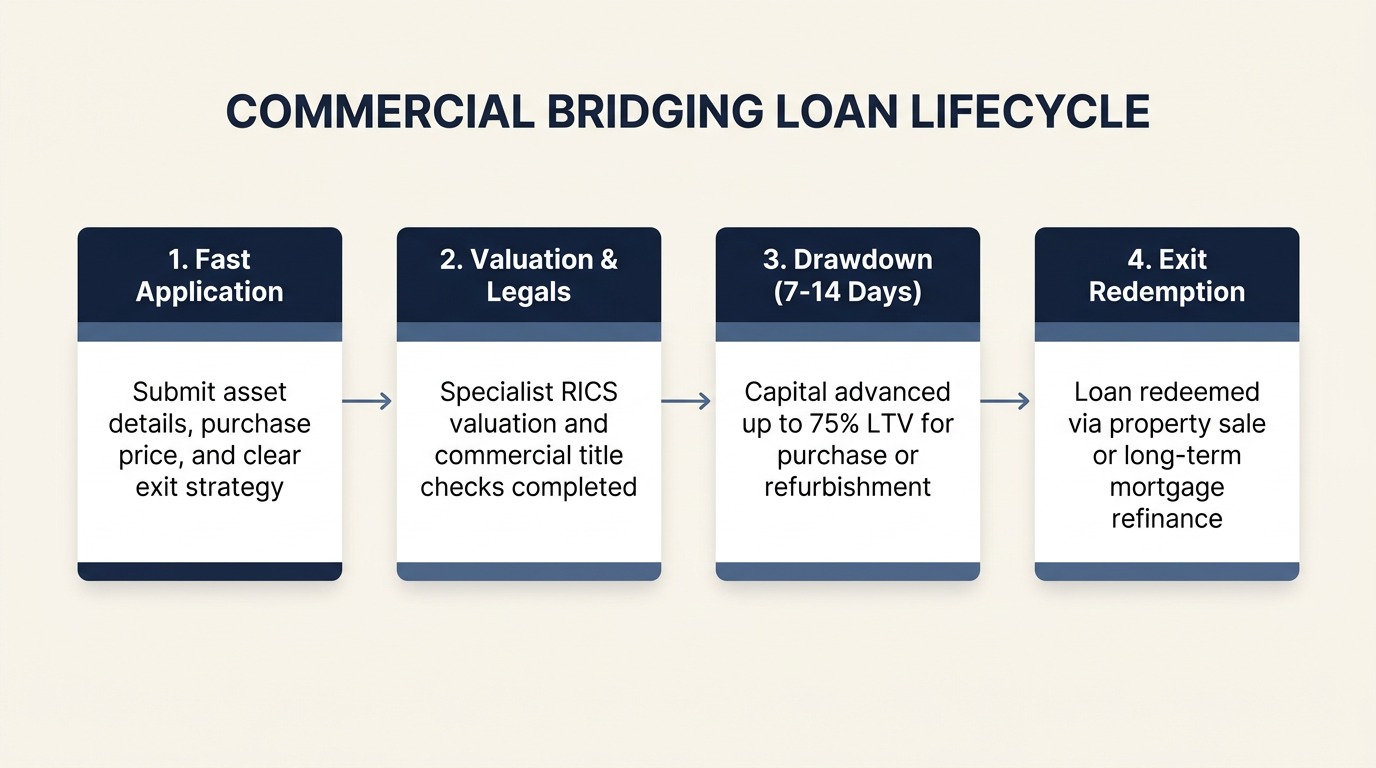
The 4-Step Operational Lifecycle of a Bridging Loan
Managing a commercial bridging transaction requires structured coordination between the borrower, the specialist lender, independent RICS valuers, and commercial conveyancers.
Step 1: Rapid Application and Agreement in Principle
The process begins with an initial financial assessment. The borrower or their commercial finance broker presents the core transaction parameters: the property purchase price, current open market value, development budget (if applicable), and proposed exit plan. Most specialist lenders issue a formal Agreement in Principle (AIP) within 24 hours, outlining provisional loan amounts, monthly interest rates, and facility charges.
Step 2: Valuation and Legal Diligence
Once the AIP is accepted, the lender instructs an independent valuation from a Royal Institution of Chartered Surveyors (RICS) registered valuer. The valuer inspects the commercial asset to assess its current vacant possession value, 90-day liquidation valuation, and projected Gross Development Value (GDV).
Concurrently, the lender’s solicitors initiate commercial title checks, reviewing local authority searches, planning permissions, environmental reports, and existing commercial leases. Borrowers can accelerate this phase by instructing a conveyancer experienced in expedited commercial property transactions.
Step 3: Facility Execution and Capital Drawdown
Following satisfactory survey results and legal sign-off, the lender issues binding facility documentation. Company directors sign personal guarantees and debentures, and the legal charge is registered at HM Land Registry and Companies House. Funds are then transferred via CHAPS to the borrower’s solicitor for immediate completion. In urgent auction scenarios, streamlined lenders can conclude this entire sequence in as few as seven business days.
Step 4: Project Execution and Exit Redemption
With capital in hand, the borrower completes their commercial objective, such as refurbishing retail space, converting commercial premises into flats under Class MA permitted development, or stabilizing tenant leases. Once the value is added, the borrower executes their predetermined exit strategy, repaying the gross bridging facility in full from property sale receipts or refinancing onto long-term debt.
Commercial Bridging Loans vs Commercial Mortgages
Understanding the operational boundaries between short-term bridging finance and long-term commercial mortgages prevents developers from deploying expensive capital inappropriately.
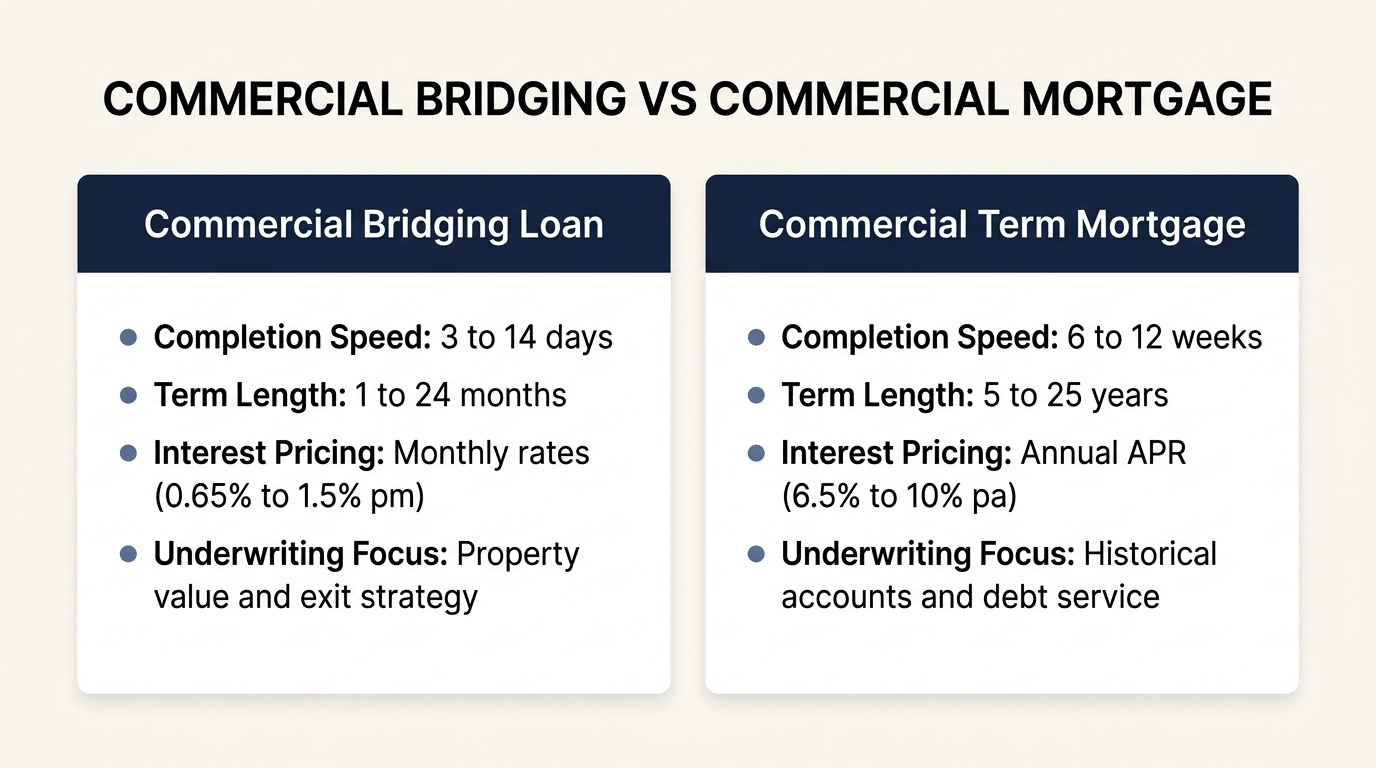
The comparative matrix below outlines the structural trade-offs between both commercial debt instruments.
According to UK Finance commercial property lending data, commercial bridging finance serves as an essential transition facility that feeds stabilized assets into the mainstream banking system. Without bridging debt, many viable brownfield development projects and commercial refurbishments would stall due to rigid institutional lending rules.
Interest Pricing Structures: Serviced, Retained & Rolled-Up
Because commercial bridging loans operate over short durations, lenders offer three distinct methods for handling interest charges. Selecting the right interest structure ensures your project avoids premature cash flow exhaustion during construction or refurbishment.
1. Serviced Interest
Under a serviced interest structure, the borrower pays the agreed monthly interest charge directly out of corporate cash flow each month, exactly like an interest-only mortgage. Because interest is settled as it accrues, the borrower receives the maximum possible net advance on completion day. This structure suits trading companies with consistent operational income that want to minimize total interest compounding.
2. Retained Interest
With retained interest, the lender calculates the total interest due across the agreed term (for instance, 12 months) and deducts that full amount from the gross loan advance on day one. The borrower makes zero monthly interest payments during the project. If the borrower exits the loan early (for example, in month seven), reputable lenders refund the unexpired portion of the retained interest.
3. Rolled-Up Interest (Compounded)
Rolled-up interest means that interest accrues monthly and is added directly onto the loan balance. No monthly payments are made, and no upfront interest deduction is withheld from your initial loan advance. Instead, the principal and all compounded interest charges are repaid together as a single lump sum when the loan is redeemed. While this preserves immediate construction capital, compound interest increases the total debt burden over time.
The table below models net capital received across a typical £500,000 commercial bridging loan at 0.85% per month over a 12-month term, assuming a 2% arrangement fee.
Working capital needs during construction projects can also be augmented by agile commercial lines such as instant business loan options or invoice discounting facilities to support day-to-day trade cash flow.
Ancillary Costs and Fee Transparency
When calculating the viability of a commercial bridging transaction, borrowers must account for all mandatory ancillary charges. Working with lenders adhering to the Bridging and Development Lenders Association lending standards ensures that fee schedules are disclosed transparently at the outset.
Common costs associated with commercial bridging facilities include:
- Facility / Arrangement Fee: An administrative charge levied by the lender, typically ranging between 1.0% and 2.0% of the gross loan amount, usually deducted from loan proceeds or capitalized onto the loan balance.
- Valuation Fees: The cost of the professional RICS commercial valuation report, payable by the borrower prior to formal loan approval (typically £1,200 to £3,500 depending on property complexity).
- Legal Costs: Commercial bridging involves dual legal representation. The borrower must pay both their own solicitor’s fees and the lender’s independent legal fees.
- Broker Fees: Commercial finance brokers typically charge an arrangement fee (often 1.0% of the loan amount or a fixed fee) for sourcing and structuring the facility across specialist non-bank funds.
- Exit Fees: While many premier bridging lenders charge zero exit fees, certain providers charge an exit fee of 1.0% to 1.5% of the gross advance upon loan redemption.
Core Commercial Use Cases in the UK Market
Commercial bridging loans are engineered for high-impact commercial scenarios where standard funding fails to meet operational realities.
1. Property Auction Purchases (28-Day Deadline)
When purchasing commercial property under the hammer at UK property auctions (such as Acuitus, Allsop, or Clive Emson), buyers must pay a 10% deposit immediately and legally complete the purchase within 28 calendar days. Traditional mortgage underwriting cannot meet this timeframe. Bridging finance allows buyers to secure the purchase quickly, avoiding the forfeit of their 10% deposit and auction penalty fees.
2. Commercial-to-Residential Conversions (Class MA)
Under UK Permitted Development rights (Class MA), investors can convert vacant commercial buildings, offices, and retail premises into residential housing without submitting a full planning application. Because the property is uninhabitable during conversion, high-street banks refuse to lend. A commercial bridging loan funds the purchase and light refurbishment works, which is subsequently refinanced onto buy-to-let or build-to-rent debt.
3. Chain-Breaking on Commercial Transactions
If a business is expanding into new commercial headquarters and needs to complete the purchase before their existing premises are sold, a commercial bridging loan prevents the acquisition from falling through. The bridge is secured against both properties and redeemed once the old building completes its open-market sale.
4. Heavy Refurbishment and Repurposing
Commercial buildings suffering from structural neglect, broken leases, or poor Energy Performance Certificate (EPC) ratings below statutory minimums cannot secure standard mortgage debt. Bridging finance provides capital to upgrade energy efficiency ratings, reconfigure floorplans, and secure creditworthy commercial tenants before exiting onto term finance.
The Non-Negotiable Requirement: A Solid Exit Strategy
Unlike personal loans where affordability is judged on monthly salary, a commercial bridging loan is approved or declined based on the credibility of the exit strategy. The lender’s primary question is simple: How will this loan be repaid in full?
Exit Route 1: Refinance onto Long-Term Debt
The most frequent exit strategy is refinancing the stabilized asset onto long-term commercial property finance, such as specialized limited company mortgages. This pathway requires that the planned refurbishment or conversion elevates the property to standard mortgageable condition within the bridging tenure.
Exit Route 2: Open Market Sale
For property traders and developers, the exit strategy consists of selling the completed commercial or residential units on the open market. Lenders evaluate whether the local property market possesses sufficient transaction liquidity and demand to achieve the target sale price within the remaining loan term.
Managing Execution Risk and Avoiding Default Interest
Failure to execute an exit strategy before the contractual loan maturity date triggers severe financial consequences. When a loan passes its term date, lenders apply default interest rates, which typically jump to 2.0% or 3.0% per month, accompanied by hefty administrative late fees. In severe cases, the lender can appoint an Law of Property Act (LPA) receiver to take possession of the building and force a distressed sale.
To avoid default traps, experienced developers always build a 3-to-6-month buffer into their loan term. If a conversion project is scheduled to take nine months, securing an 18-month facility provides adequate insulation against contractor delays, supply chain shortages, or conveyancing bottlenecks.
Frequently Asked Questions
How fast can a commercial bridging loan complete in the UK?
Standard commercial bridging loans complete within 7 to 14 business days from initial enquiry. In straightforward cases with clean title deeds and rapid desktop or drive-by valuations, specialist lenders can complete urgent applications in as few as 3 to 5 business days.
What is the maximum Loan-to-Value (LTV) on a commercial bridge?
Commercial bridging lenders typically advance up to 65% to 75% LTV against the open market valuation of the property. However, if the borrower can offer additional security (such as a legal charge over another unencumbered commercial or residential property), lenders can advance up to 100% of the purchase price and construction costs.
Are commercial bridging loans regulated by the Financial Conduct Authority?
No, commercial bridging loans secured against commercial property, offices, industrial units, or residential buy-to-let properties held for investment purposes are unregulated by the FCA. Regulation applies strictly to loans secured against property that is or will be occupied by the borrower or their close family members.
Can a startup or new company get a commercial bridging loan?
Yes, newly formed limited companies and Special Purpose Vehicles (SPVs) can access commercial bridging finance. Because underwriting is secured against property value and exit viability rather than historical company accounts, trading history is not a mandatory requirement, provided directors have relevant property or business experience.
What happens if I want to repay a bridging loan early?
Most reputable commercial bridging lenders allow early repayment without punitive penalties, especially after an initial minimum period (often 1 to 3 months). If you opted for a retained interest facility, any unexpired retained interest is credited back upon final settlement.
Do commercial bridging loans require a personal guarantee?
Yes, when lending to a corporate entity or limited company, almost all UK bridging lenders require personal guarantees from company directors and major shareholders holding 20% or more of share capital. This ensures directors remain personally committed to executing the project’s exit strategy.
The Bottom Line: How to Proceed
A commercial bridging loan is an agile, high-leverage financing instrument that allows UK commercial property developers and corporate operators to execute rapid acquisitions and capitalize on lucrative market dislocations. By bypassing the sluggish underwriting cycles of traditional clearing banks, bridging finance unlocks opportunities that would otherwise be lost.
However, bridging capital comes at a cost. High monthly rates and compounding interest structures mean that bridging debt must never be treated as open-ended financing. Prepare a realistic project timeline with built-in contingency buffers, confirm that your exit strategy is rigorously tested, and partner with accredited commercial lenders to ensure your development yields maximum financial return.