
Quick Answer: Workplace Pension Compliance 2026
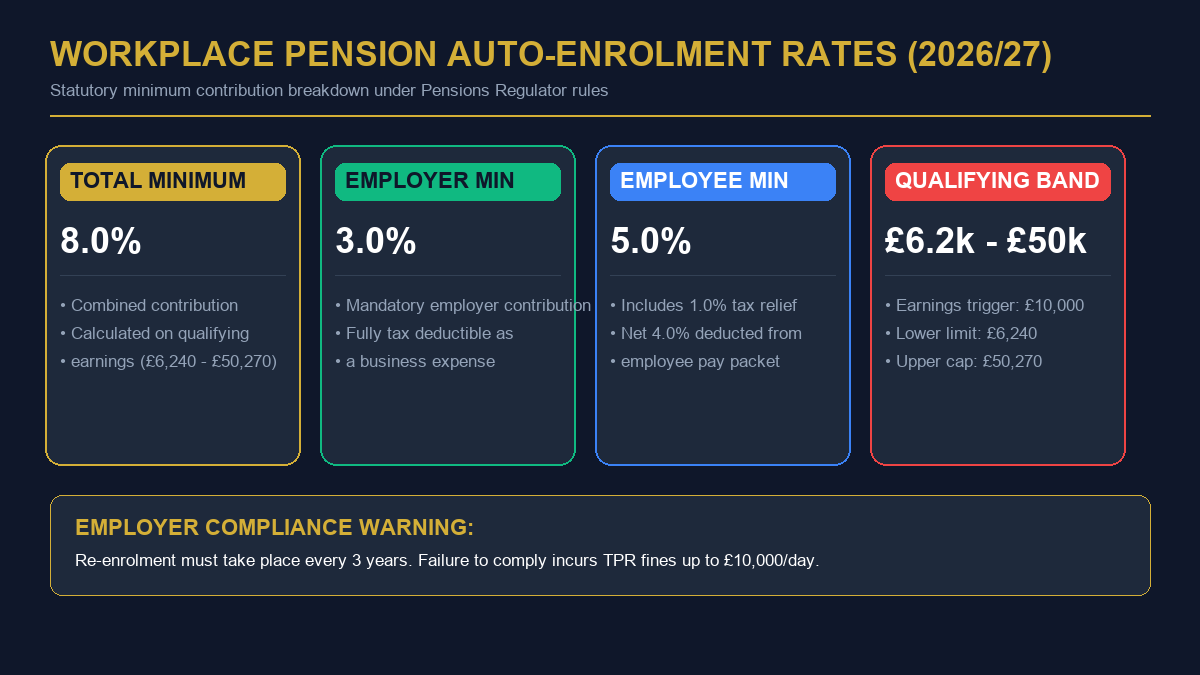
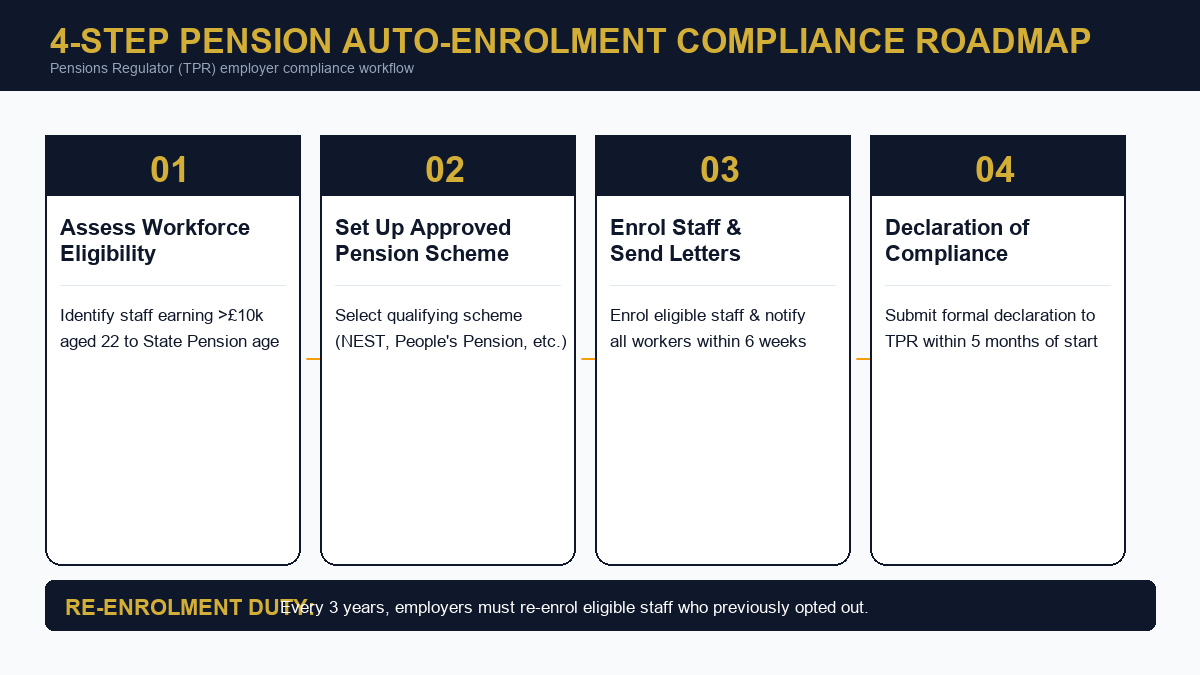
UK employers must automatically enrol eligible workers into a workplace pension scheme. The statutory minimum contribution rate is 8% of qualifying earnings, with at least 3% contributed by the employer and 5% contributed by the employee (which includes 1% tax relief). Auto-enrolment applies to employees aged between 22 and State Pension age who earn over £10,000 per year. Contributions are calculated on qualifying earnings between £6,240 and £50,270. Employers must re-enrol eligible opted-out staff every 3 years and submit a Declaration of Compliance to The Pensions Regulator (TPR).
Key Takeaways
- Total minimum contribution remains 8% (3% employer / 5% employee) calculated on qualifying earnings (£6,240 to £50,270).
- The automatic enrolment earnings trigger remains £10,000 per year for workers aged 22 to State Pension age.
- Employer pension contributions are 100% tax-deductible against Corporation Tax and exempt from Employer National Insurance.
- Employers must perform re-enrolment every 3 years and maintain statutory payroll records for 6 years.
For UK business owners, HR managers, and payroll leaders, workplace pension compliance is a mandatory legal responsibility overseen by The Pensions Regulator (TPR) official site. Failure to automatically enrol eligible staff or miscalculating contribution thresholds exposes employers to substantial statutory fines and enforcement notices.
According to regulatory compliance figures published by TPR, thousands of compliance checks are conducted annually. Maintaining strict adherence to enrolment triggers, contribution percentages, and 3-year re-enrolment cycles ensures businesses avoid penal sanctions while supporting staff retirement planning.
This guide explains workplace pension auto-enrolment rules in 2026, contribution rates across salary bands, employer tax advantages, and the 4-step compliance pathway.
1. Worker Eligibility & Earnings Triggers
Employers must assess staff every pay period. Worker classification dictates your legal duties:
| Worker Category | Age & Earnings Criteria | Employer Duty |
|---|---|---|
| Eligible Jobholder | Aged 22 to State Pension age; earns over £10,000/yr | Must automatically enrol & pay employer contributions |
| Non-Eligible Jobholder | Aged 16–21 or SPA–74 (earns >£10k); or aged 16–74 (earns £6,240–£10k) | Has right to opt in; employer MUST contribute if they opt in |
| Entitled Worker | Aged 16–74; earns under £6,240/yr | Has right to join; employer is NOT required to contribute |
For company directors structuring personal remuneration alongside pension contributions, review our guide to optimal salary and dividend split for UK directors.
2. Contribution Rates & Qualifying Earnings Band
Pension contributions are calculated on qualifying earnings — the portion of gross pay between £6,240 and £50,270 per year (£120 to £967 per week).
Calculation Example:
An employee earns a gross salary of £30,000 per year:
- Deduct lower threshold: £30,000 – £6,240 = £23,760 qualifying earnings.
- Employer 3% Contribution: £23,760 × 3% = £712.80 / year.
- Employee 5% Contribution: £23,760 × 5% = £1,188.00 / year (includes tax relief).
- Total annual pension investment: £1,900.80 / year.
Employer pension contributions also reduce your secondary Class 1 tax obligations — check details in our analysis of employer national insurance contributions 2026 rates.
3. Employer Tax Advantages: Salary Sacrifice
Structuring workplace pensions via Salary Sacrifice generates significant tax savings for both employer and employee:
- Employer NIC Savings: Employers save 15% Employer NIC on every pound of salary sacrificed into a pension.
- Corporation Tax Relief: Employer pension contributions are allowable business expenses, reducing net taxable profit for Corporation Tax.
To evaluate statutory redundancy rules alongside staff benefit commitments, see statutory redundancy pay UK rules.
4. Frequently Asked Questions
Can an employee opt out of a workplace pension?
Yes. Employees can opt out within 1 month of being enrolled and receive a full refund of contributions. However, employers cannot encourage or induce staff to opt out.
What is the 3-year re-enrolment duty?
Every 3 years from your original staging date, employers must re-assess and re-enrol any workers who previously opted out, then submit an updated Declaration of Compliance to TPR.
Your Next Actions
- Audit Qualifying Earnings: Re-verify that payroll software calculates pension deductions accurately on the £6,240–£50,270 band.
- Check Re-Enrolment Deadline: Confirm your 3-year re-enrolment date with The Pensions Regulator.
- Implement Pension Salary Sacrifice: Consult your accountant to implement pension salary sacrifice and save 15% Employer NIC.
- Explore Tools: Use resources in our Business Tools Hub.
Editorial Team & Signature
Written by Oliver Carpenter, Founder & Editor-in-Chief at Elite Business Journal. Published August 2026.
In addition to mandatory pension contributions, compensation reviews require tactical preparation; see our guide on how to negotiate your salary.
Competitive benefits play a vital role in curbing staff turnover; explore the macro factors driving UK talent exodus and employee retention.