More Than 400,000 Private Limited Companies Are Registered Every Year in the UK, But Nearly Half Struggle Within Five Years
Here’s why that happens. Many business owners jump into forming a limited company because someone told them it saves tax. They miss the hidden costs and legal responsibilities that catch up later. This article shows you exactly what you gain and what you give up when you form a private limited company in the UK, so you can make the right choice for your specific situation.
Who This Is For
You’re at the stage where your side business is making real money or you’re about to quit your job and start something new. Maybe you’ve been trading as a sole trader and wonder if it’s time to switch. Or you’re comparing your options before you even register anything.
This matters most if you’re making or expecting to make more than £20,000 a year in profit. Below that threshold, the benefits usually don’t outweigh the admin costs. You want facts, not cheerleading, because you’re about to make a decision that affects your money and your time for years.
What a Private Limited Company Actually Means
A private limited company is a separate legal entity from you as a person. When you form one, you create a business that exists independently in the eyes of the law. You become a director and usually a shareholder, but you are not the same thing as the company itself.
This separation creates both protection and obligation. The company owns its assets, holds its bank accounts, and takes on its debts. You run it as a director and own a piece of it as a shareholder. Most small business owners in the UK who choose this structure own 100% of the shares and act as the sole director.
About 4.5 million private limited companies currently operate in the UK. They range from one person consulting businesses to growing companies with dozens of employees. The structure works the same whether you turn over £30,000 or £3 million, though the benefits shift based on your profit level.
Setting one up costs £50 if you do it directly through Companies House (updated under the Economic Crime and Corporate Transparency Act), or between £50 and £200 if you use a formation agent. The real costs come later in accounting fees and time spent on compliance.
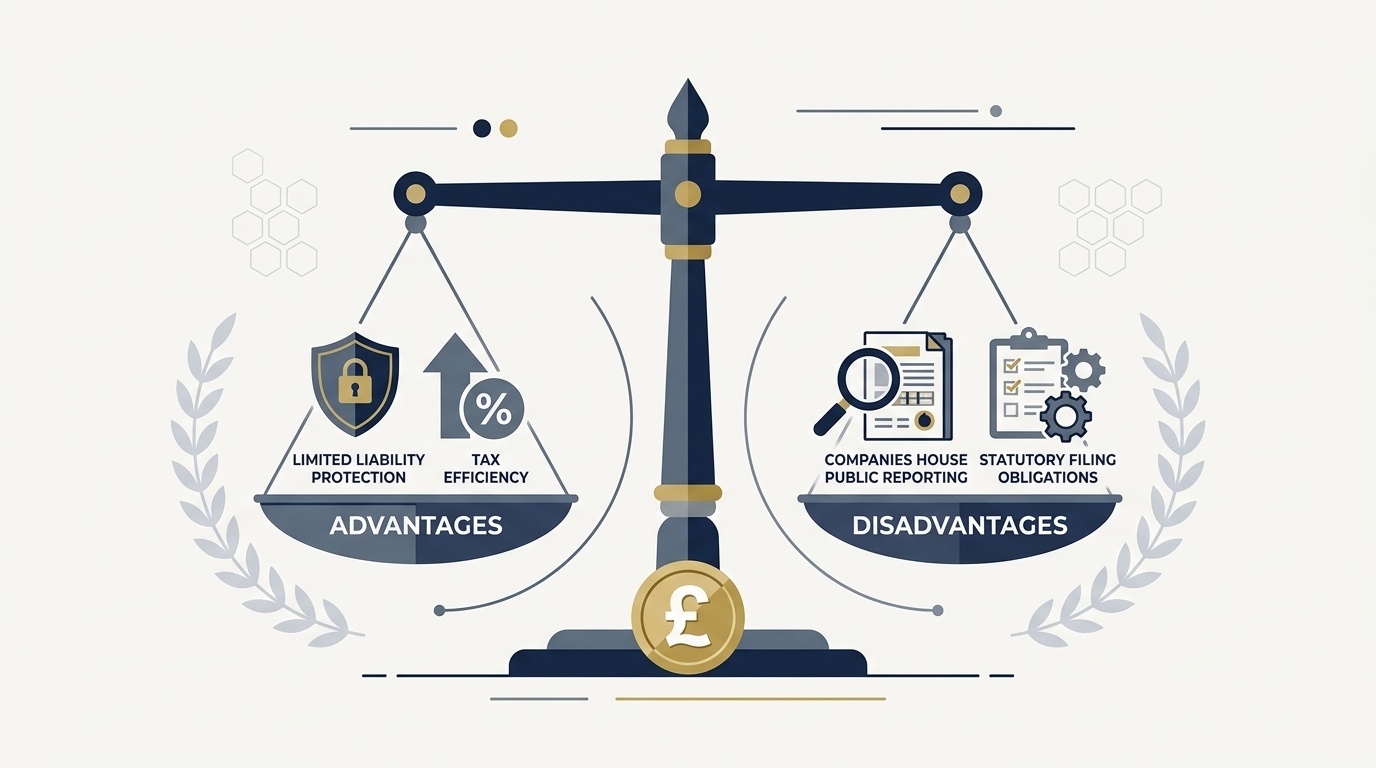
The Real Advantages of a Private Limited Company in the UK
You Get Strong Legal Protection for Your Personal Assets
Limited liability means your personal money stays separate from business debts. If the company fails and owes £50,000, creditors can only go after the company’s assets, not your house or savings. This protection applies as long as you run the business properly and don’t sign personal guarantees.
This matters most if you’re taking business risks like signing long leases, hiring employees, or taking on large client contracts. A freelance graphic designer working from home faces different risk than someone opening a retail shop with a three-year lease. One misstep as a sole trader in a high-risk business could wipe out everything you own.
However, banks often ask directors of small companies to sign personal guarantees for loans or commercial leases. When you sign these, you lose the protection for that specific debt. Read everything before you sign, because that personal guarantee turns your limited liability back into unlimited risk.
Corporation Tax Usually Costs You Less Than Income Tax
Private limited companies pay corporation tax on profits according to current corporation tax rates set by HMRC—19% for profits up to £50,000, and 25% for profits above £250,000. As a sole trader, you pay income tax at 20% on earnings between £12,571 and £50,270, then 40% above that, plus National Insurance on top.
Let’s say your business makes £60,000 profit. As a sole trader, after your personal allowance, you’d pay roughly £16,432 in income tax and National Insurance. As a limited company, you’d pay around £11,750 in corporation tax, then choose when and how to extract the rest as salary and dividends.
You can leave profits in the company and only take out what you need to live on. This flexibility helps with tax planning and smoothing your income across years. When you have a great year, you don’t have to pull all the profit out and pay higher rate tax on it immediately.
The tax saving gets bigger as your profit grows. Below £20,000 profit, the admin costs often eat up the tax savings. Above £50,000, the math tilts heavily toward a limited company.
Your Business Looks More Credible to Clients and Partners
Some larger companies and government bodies only work with limited companies. They see it as more professional and easier to manage for their procurement and payment systems. Adding “Limited” or “Ltd” after your business name signals you’ve met legal requirements and committed to the structure.
This perception matters differently depending on your industry. If you’re bidding for corporate contracts or B2B work, being a limited company often gets you taken more seriously. A consultancy called “Smith Consulting Ltd” typically gets more respect than “John Smith, Consultant” when pitching to enterprise clients.
Banks also treat limited companies differently when you apply for business loans or credit. You’ll need to show accounts and prove the company’s creditworthiness, but you’re often eligible for better terms and higher amounts than sole traders.
You Can Plan Your Income for Better Tax Efficiency
As a director and shareholder, you choose how to pay yourself. Most people take a small salary up to the National Insurance threshold (£12,570 in 2026/27) plus dividends for the rest. Dividends are taxed differently than salary, with a £500 tax-free allowance and lower rates after that.
This split saves on National Insurance contributions, which both employers and employees pay on salary. On a £50,000 extraction, you might save £5,000 to £8,000 per year compared to taking it all as salary. That’s real money back in your pocket or your business.
You also control timing. If you have a lower income year coming up, you can delay dividend payments to that year and pay less tax. If you’re planning to drop to part-time or take a sabbatical, you can time your income extraction around it.
Your spouse or partner can be a shareholder too. If they’re in a lower tax bracket or not working, you can pay dividends to them (as long as they genuinely own shares and it reflects real ownership). This splits income across two people and can save thousands in tax legally.
The Company Continues Beyond You
A limited company doesn’t die when you do or when you want to step back. You can sell the business as a going concern, transfer shares to family members, or bring in partners by issuing new shares. This makes succession planning much cleaner.
If you want to exit in five or ten years, selling shares in a limited company is simpler than selling a sole trader business. Buyers get a complete legal entity with its own contracts, bank accounts, and history. You might also qualify for Business Asset Disposal Relief (formerly Entrepreneurs’ Relief), which taxes the first £1 million of gains at just 10% when you sell.
This benefit matters more as your business grows and becomes an asset worth selling. For someone planning to build and exit, starting as a limited company from day one makes that path smoother.
The Real Disadvantages of a Private Limited Company in the UK
You Face Ongoing Admin Costs and Legal Requirements
Every private limited company must meet Companies House filing requirements, including annual accounts and a company tax return with HMRC. You need to keep detailed records of all business transactions, director decisions, and shareholder meetings (even if you’re the only person involved).
Most small business owners pay an accountant £800 to £2,500 per year to handle this. You can do it yourself using accounting software, but you still need to know company law and tax rules. Get it wrong and you face fines starting at £150 for late accounts, escalating to £1,500 for seriously late filings.
You also need to file a confirmation statement every year updating Companies House about your directors, shareholders, and registered office address. This costs £13 and must be done even if nothing changed. Missing deadlines can lead to your company being struck off the register.
The time cost adds up too. You’ll spend hours on bookkeeping, reviewing accounts, making formal decisions, and keeping records that sole traders never think about. For someone making £15,000 profit, this overhead makes no sense.
Your Financial Information Becomes Public
Companies House publishes your annual accounts online for anyone to see. Your competitors, clients, suppliers, and neighbors can look up your company and see your turnover, profit, assets, and debts. Only very small companies (turnover under £10.2 million) can file abbreviated accounts with less detail, but even those show your net worth.
This transparency bothers people who value privacy. Your clients might see you made a huge profit and ask why you’re raising prices. Your suppliers might see you struggling and demand payment upfront. Your competitors get free insight into your financial health.
Director details also go public, including your name, date of birth (month and year), nationality, and service address. You can use a registered office service to keep your home address private, but your name and role are always visible.
There’s no hiding behind a business name. Anyone who wants to know who runs the company and how it’s doing financially can find out in two minutes online.
You Can’t Just Take Money Out Whenever You Want
The company’s money is not your money until you formally extract it as salary, dividends, expenses, or loans. You need to follow legal procedures for each type of payment. Just transferring cash from the business account to your personal account without documentation creates tax problems and illegal director’s loans.
Director’s loans over £10,000 create a benefit in kind tax charge. If you don’t repay within nine months of the company’s year end, the company pays a 33.75% tax charge on the loan amount (you get it back when you repay, but it ties up cash). Borrowing from your own company becomes surprisingly complicated.
You also can’t pay dividends if the company doesn’t have enough retained profit. If you pay an illegal dividend, you must repay it. This becomes a problem when the company has a bad year but you still need to pay your mortgage.
Sole traders just take money out whenever they need it. No paperwork, no legal procedures, no restrictions. For people who hate admin and want simple access to their earnings, this limited company restriction feels like a cage.
More Paperwork Means More Ways to Get Fined
Companies House and HMRC issue automatic penalties for late or incorrect filings. File your accounts one day late and you get a £150 fine. Three months late costs £375. Six months late costs £750. A year late costs £1,500. These fines apply even if you don’t owe any tax.
Fail to notify HMRC about a new director within three months and you face penalties up to £3,000. Don’t keep proper records and you can be disqualified as a director. Miss your corporation tax payment and you pay interest and potential penalties on top.
The penalty system assumes you know all the rules and deadlines. Many first-time company directors get caught out in year one because they didn’t know about a requirement. Ignorance is not a defense. The fines still apply and stack up fast.
You Need to Run It Properly or Face Personal Liability
Limited liability only protects you if you run the company legally and keep it separate from your personal affairs. Mix business and personal money, trade while insolvent, or commit fraud, and directors can be held personally liable for company debts.
This concept is called “piercing the corporate veil.” Courts can ignore the separation between you and the company if you abuse the structure. Examples include using company money for personal expenses without proper documentation, continuing to trade when you know the company can’t pay its debts, or deliberately misleading creditors.
Wrongful trading laws mean directors can be personally liable if they keep running a company that’s clearly going under. If you know you can’t pay your debts but keep taking on work and running up more bills, you lose your limited liability protection.
Most honest business owners never face this problem, but you need to treat the company as a separate entity. That means separate bank accounts, proper bookkeeping, and formal decisions even when you’re the only person involved.
Setting Up Costs More Upfront and Takes More Time
Registering a limited company takes a few hours minimum if you know what you’re doing. You need to choose a company name that’s not already taken, appoint directors, decide on share structure, create articles of association, and register everything with Companies House.
You’ll also need a business bank account, which takes longer to set up for limited companies than sole traders. Banks want to see your incorporation documents, verify directors’ identities, and run credit checks. The process can take two to three weeks.
You need accounting software from day one, not later when things get complicated. Limited companies have legal bookkeeping requirements that go beyond simple income and expenses tracking. Budget £10 to £30 per month for decent software.
Many people also pay a solicitor or accountant to help set things up correctly, adding £200 to £1,000 to initial costs. Get the share structure wrong at the start and fixing it later costs much more.
Closing Down a Limited Company Is Harder Than Stopping as a Sole Trader
When you’re done with a sole trader business, you just stop trading and tell HMRC. Total cost: zero. Total time: a few minutes online. When you want to close a limited company, you need to formally dissolve it through Companies House.
The cheapest way is applying to strike off the company, which costs £10 but takes three months and requires the company to have no debts, assets, or trading activity for three months before you apply. You need to settle all tax bills, close the bank account, and notify everyone who might object.
If the company has assets or debts, you need a formal liquidation, which costs £1,500 to £5,000 depending on complexity. A licensed insolvency practitioner must handle it, investigate the directors’ conduct, and distribute any remaining assets properly.
You also can’t just abandon a company because the admin got too much. It stays on the register and you remain legally responsible as a director until it’s properly closed. Companies House will eventually strike it off for not filing, but you’ll have collected penalties and possibly a director disqualification along the way.
You Might Lose Certain Tax Reliefs and Benefits
Sole traders can claim some tax reliefs that limited company directors can’t. Trading losses as a sole trader can be offset against other income immediately. Limited company losses can only be used against future company profits or carried back one year in most cases.
If you’re claiming tax credits or universal credit, company dividends count as income and might reduce your benefits more than equivalent sole trader profits would, depending on how the calculation works.
You also lose the simplicity of the tax system. Sole traders file one Self Assessment tax return per year. Limited company directors file a company tax return, a personal Self Assessment for their salary and dividends, and possibly payroll reports if taking a salary.
Some grants, business support programs, and competitions specifically target sole traders or exclude limited companies, or vice versa. Check the rules for anything you’re applying for, because your business structure might make you ineligible.
What Most Articles Get Wrong About Limited Companies
Most guides present limited companies as the obvious upgrade from sole trader status once you’re making decent money. They make it sound like a one-way ladder you climb as you get more successful.
The truth is messier. Some very profitable business owners stay as sole traders because they value simplicity and privacy over tax savings. Others form limited companies early because they’re in high-risk industries or planning to raise investment, even though their profits don’t justify it yet.
The right answer depends on your specific situation, personality, and goals. Someone who hates paperwork and makes £35,000 profit might be happier paying an extra £1,500 in tax and staying a sole trader. Someone making the same amount but planning to scale to £200,000 in three years should probably start as a limited company now to establish the structure and credit history.
Stop thinking of business structures as status symbols or achievement levels. Think of them as tools. Pick the tool that fits your specific job, not the one that sounds most impressive.
How to Decide if a Limited Company Is Right for You
Start by calculating the actual tax difference for your expected profit level. Use HMRC’s tax calculators or ask an accountant to run the numbers for your specific situation. Compare the tax saving against the accounting costs and your time. If you save less than £1,000 per year, the hassle probably outweighs the benefit.
Next, assess your risk level honestly. What could go wrong in your business that would create debts you can’t pay? If you’re signing leases, hiring staff, or holding stock, limited liability becomes valuable insurance. If you’re a consultant working from home with no overhead, the risk is minimal.
Look at your clients and industry. Do the people you want to work with expect or require a limited company? Will it open doors or make no difference? Call a few potential clients and ask if your business structure matters to them.
Consider your growth plans. If you want to bring in partners, raise investment, or sell the business in five years, start as a limited company now. If you’re building a lifestyle business to replace your salary and nothing more, sole trader might serve you better.
Finally, be honest about your admin tolerance. If keeping receipts and filing one tax return per year feels like torture, running a limited company will make you miserable. The structure doesn’t change your personality. Some people should stay sole traders purely because they’ll never keep up with the compliance requirements, regardless of the tax benefits.
Making Your Decision and Taking Action
The single most important thing to remember is that you can change your mind later. Starting as a sole trader and switching to a limited company when it makes sense is completely normal. Thousands of business owners do it every year.
If you’re still unsure, start as a sole trader. You can register in minutes, start trading today, and keep things simple while you test your business idea and build up profit. When you consistently make over £30,000 profit and the business feels stable, that’s the natural time to reconsider.
If you’ve decided a limited company makes sense now, talk to an accountant before you register. One hour of advice up front will save you hours of problems later. They’ll help you structure shares correctly, understand your specific tax situation, and set up systems properly from day one.