Quick Answer: UK Employment Contracts & Section 1 Statements 2026
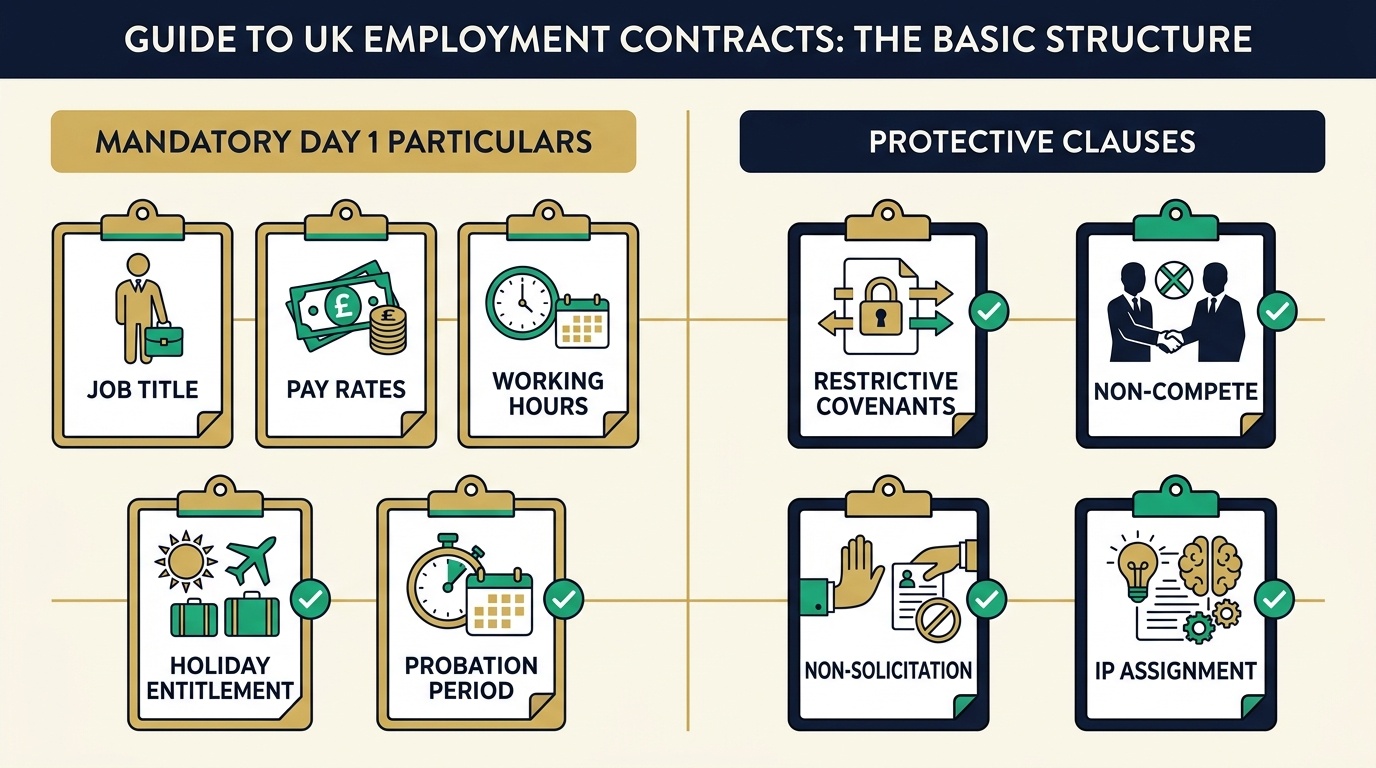
Under UK employment law, employers are legally required to provide all employees and workers with a written statement of employment particulars (Section 1 statement) on or before their first day of work. Mandatory Day 1 particulars include employer and employee names, job title, start date, pay rate and pay frequency, working hours, holiday entitlement, mandatory training, notice periods, and probationary period terms. A comprehensive contract should also include protective clauses such as restrictive covenants (non-compete and non-solicitation), confidentiality, and automatic intellectual property assignment.
Key Takeaways
- Section 1 written statements are a statutory Day 1 right for both employees and workers under the Employment Rights Act 1996.
- Probationary periods must be explicitly defined in writing, including duration, review mechanisms, and notice terms.
- Restrictive covenants (non-compete, non-solicitation) must be narrowly drafted to protect legitimate business interests without acting as a restraint of trade.
- Employers must automatically enrol qualifying staff into an approved workplace pension within statutory deadlines.
For UK business founders, managing directors, and HR leaders, issuing well-structured employment contracts is both a statutory legal obligation and a vital business protection mechanism. A clear, compliant contract aligns expectations from day one, mitigates workplace disputes, and protects valuable company assets, client relationships, and intellectual property.
According to official employment statutory frameworks from ACAS (Advisory, Conciliation and Arbitration Service) and the Employment Rights Act 1996 on legislation.gov.uk, failing to provide compliant written particulars exposes employers to Employment Tribunal claims where compensation of up to four weeks’ statutory pay can be awarded.
This guide explains UK employment contract requirements in 2026, detailing mandatory Section 1 written particulars, enforceable restrictive covenants, probationary period rules, and statutory onboarding compliance.
1. Section 1 Written Statement: Mandatory Day 1 Particulars
Under Section 1 of the Employment Rights Act 1996, every employee and worker is legally entitled to a written statement of employment particulars on or before their first day of work.
Core Particulars That MUST Be Provided by Day 1:
- Names & Identities: Full legal names of the employer and employee/worker.
- Start Date: The official date employment begins and the date continuous employment started.
- Job Title & Duties: Clear job title or a concise description of responsibilities.
- Place of Work: Specified work address or notice of hybrid/mobile working requirements.
- Remuneration: Gross pay rate, calculation method, and payment intervals (e.g., monthly BACS on the last working day).
- Working Hours: Standard weekly hours, working days, and whether overtime is mandatory or voluntary.
- Holiday Entitlement: Annual statutory leave (minimum 28 days for full-time staff including bank holidays) and holiday pay calculation rules.
- Probationary Period: Exact length and conditions of probation (e.g., 3 or 6 months with 1 week notice).
- Mandatory Training: Any obligatory training courses provided or required by the employer.
- Notice Periods: Statutory or contractual notice required by both employer and employee.
If you are registering a new business entity to hire your first employees, follow our step-by-step guide on how to register a company in the UK.

2. Probationary Periods & Notice Terms
While “probation” is not a distinct legal status under UK statute, it is an invaluable contractual management tool for assessing new hires:
| Contractual Element | During Probationary Period | Post-Probation Confirmation |
|---|---|---|
| Notice Period | 1 week (statutory minimum after 1 month) | 1 to 3 months (contractual standard) |
| Company Sick Pay | Statutory Sick Pay (SSP) only | Enhanced contractual sick pay (if offered) |
| Disciplinary Procedure | Streamlined internal review | Full ACAS Code of Practice stages |
| Probation Extension | Permitted if contractual clause allows extension | N/A (permanent status confirmed) |
When restructuring staff roles or managing contract terminations, ensure your business adheres to statutory severance rules detailed in our guide on statutory redundancy pay UK rates and compliance.
3. Enforceable Restrictive Covenants
To prevent departing employees from damaging your business, employment contracts for senior executives, sales staff, and technical talent should include tailored post-termination restrictive covenants:
- Non-Solicitation of Clients: Restricts the departing employee from actively pitching or soliciting existing customers for a specified period (typically 3 to 6 months).
- Non-Dealing: Prevents the employee from doing business with existing clients, even if the client approaches them directly.
- Non-Poaching of Staff: Prohibits recruiting former colleagues or inducing team members to leave.
- Non-Compete: Bars working for a direct competitor within a defined geographical radius for a reasonable duration (typically 3 to 6 months).
Under English contract law, restrictive covenants are prima facie void as restraints of trade unless the employer can prove they protect a legitimate business interest (trade secrets, customer connections, stability of workforce) and go no further than reasonably necessary in duration and geographical scope.
4. Payroll, Pension & NIC Integration
Executing an employment contract triggers statutory payroll obligations under UK law:
- Workplace Pension Auto-Enrolment: Employers must automatically enrol eligible workers earning over £10,000/year and contribute at least 3% into a qualifying pension scheme. For complete compliance rules, see our guide on workplace pension compliance UK 2026.
- Employer National Insurance: Employers pay 15% Secondary Class 1 NIC on earnings above £5,000/year, offset by the £10,500 Employment Allowance. Check full thresholds in our guide to employer national insurance contributions 2026 rates.
For founder-directors structuring their own service agreements, review our analysis of the optimal salary and dividend split for UK directors.
5. Frequently Asked Questions
Can an employment contract be verbal in the UK?
While an unwritten agreement can form a legally binding contract of employment, employers are still under a strict statutory duty to issue the written Section 1 statement on or before Day 1.
What is the penalty for failing to provide a Section 1 written statement?
If an employee successfully brings a substantive tribunal claim (such as unfair dismissal or wage deductions) and the employer failed to provide a compliant written statement, the tribunal can award an additional 2 to 4 weeks’ statutory pay.
Your Next Actions
- Audit Existing Contract Templates: Review your standard employment agreements to ensure all mandatory Day 1 particulars are present.
- Review Restrictive Covenants: Ensure non-compete and non-solicitation clauses are proportionate and legally enforceable.
- Verify Onboarding Workflow: Automate delivery and electronic signing of contracts before new staff begin their first shift.
- Explore Tools: Use resources in our Business Tools Hub.
When restructuring or terminating employment agreements, calculate statutory severance liabilities using our guide to statutory redundancy pay uk.
If you are drafting contracts to expand your commercial team, follow our recruitment principles in how to hire your first salesperson.
Editorial Team & Signature
Written by Oliver Carpenter, Founder & Editor-in-Chief at Elite Business Journal. Published August 2026.