According to Companies House register data, more than 70% of the UK’s 5.5 million private limited companies operate as “close companies”, businesses controlled by five or fewer shareholder-directors. In owner-managed enterprises, the line between personal finances and corporate funds frequently blurs. Directors often transfer cash between personal and corporate accounts to cover short-term living expenses, bridge cash-flow gaps, or fund startup equipment without realising they have triggered an overdrawn Director’s Loan Account (DLA).
Under the Companies Act 2006, a private limited company is a distinct legal entity entirely separate from its shareholders and directors. Even if you own 100% of the share capital, company revenue does not belong to you personally until extracted through formal PAYE payroll, declared dividend distributions, or verified commercial expense reimbursements. Any corporate cash withdrawn outside these statutory channels constitutes a loan that must be tracked, reported, and repaid under strict HM Revenue & Customs (HMRC) provisions.
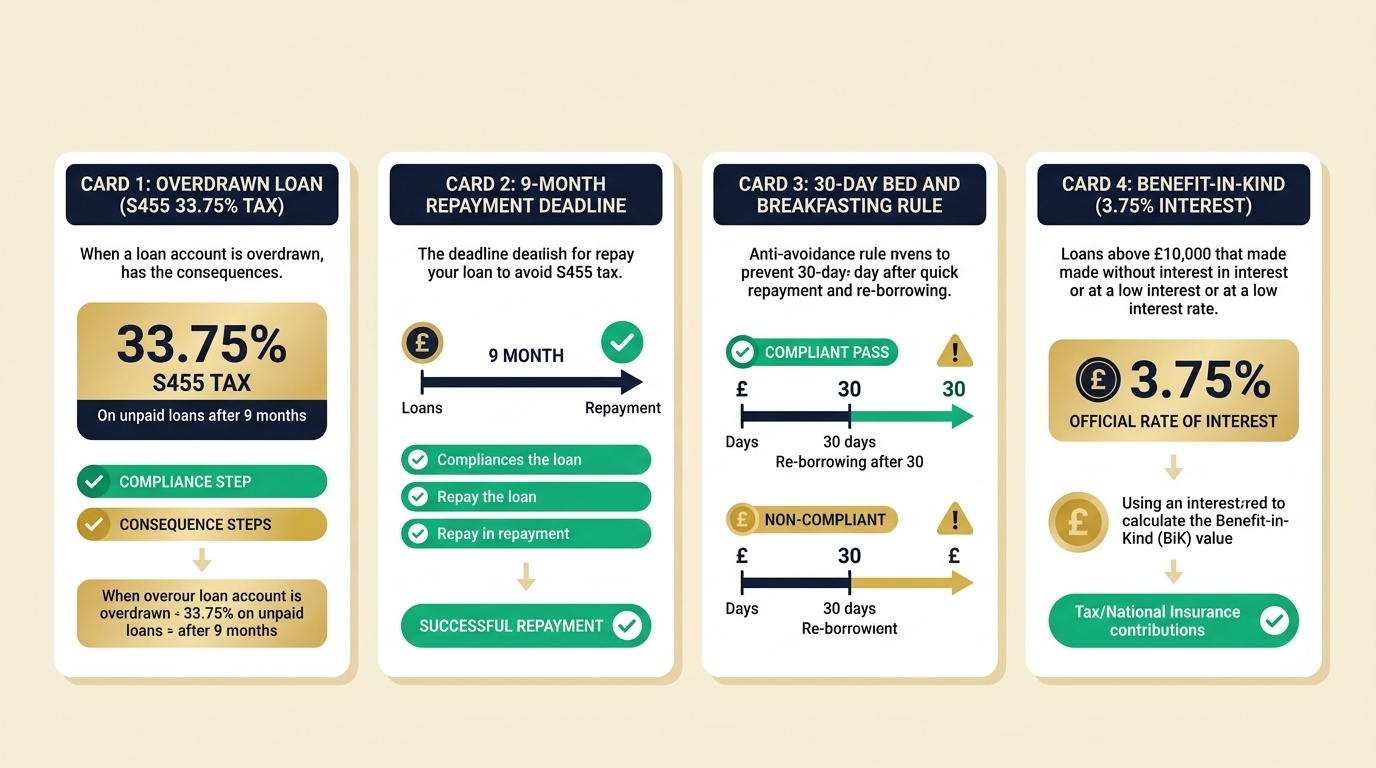
Failing to manage your Director’s Loan Account invites punitive tax liabilities. HMRC enforces a 33.75% Section 455 Corporation Tax penalty on un-repaid balances, levies Benefit in Kind (BIK) Income Tax on interest-free loans exceeding £10,000, and polices anti-avoidance rules that block short-term loan recycling. This 2026 authority guide explains the fundamental directors loan account rules in the UK, how the Section 455 tax charge works, strict repayment deadlines, and how to clear overdrawn balances tax-efficiently without jeopardising your personal wealth or company solvency.
Quick Answer: What are the directors loan account rules in the UK?
A Director’s Loan Account (DLA) tracks all funds transferred between a UK limited company and its directors that fall outside salary, dividends, or expense reimbursements. When withdrawals exceed funds contributed, the DLA becomes overdrawn. Under UK tax law, any overdrawn loan balance outstanding 9 months and 1 day after the company’s Corporation Tax accounting year-end triggers a temporary 33.75% Section 455 (S455) Corporation Tax charge, reported via Form CT600A. If an overdrawn loan exceeds £10,000 at any point in the tax year and is interest-free (or charged below HMRC’s official rate of 3.75%), it is classed as an employment Benefit in Kind (BIK), requiring P11D reporting, 13.8% Class 1A National Insurance from the company, and personal Income Tax from the director. Repaying and reborrowing within 30 days is blocked under statutory “bed and breakfasting” anti-avoidance rules.
Key Takeaways: Director’s Loan Account Rules for 2026
- The 9-Month Deadline: Overdrawn director’s loans must be repaid in full within 9 months and 1 day of your company’s financial year-end to avoid the 33.75% Section 455 Corporation Tax charge.
- Temporary Deposit Nature: S455 tax is not a permanent charge. HMRC refunds the full 33.75% tax 9 months after the end of the accounting period in which the loan is permanently repaid or written off.
- The £10,000 BIK Threshold: Overdrawing more than £10,000 without paying interest at HMRC’s official rate (3.75%) triggers P11D benefit-in-kind taxation and Class 1A employer National Insurance.
- Strict Anti-Avoidance Enforcement: HMRC’s “bed and breakfasting” rules invalidate repayments of £5,000 or more if reborrowed within 30 days, preventing artificial year-end balance clearing.
- Personal Insolvency Risk: In an insolvency or liquidation scenario, an overdrawn DLA is a company asset. Liquidators possess statutory powers to pursue directors personally for full repayment.
What Is a Director’s Loan Account (DLA) and How Does It Work?
A Director’s Loan Account is an accounting record maintained within your company’s bookkeeping ledger that logs every transaction between the company and its directors that is not formal remuneration. In practice, it acts as a virtual tab tracking whether the company owes you money or you owe the company money.
Every business transaction involving a director falls into one of four distinct accounting categories:
- PAYE Salary: Regular employment income processed through the company payroll, subject to PAYE Income Tax and employee/employer National Insurance Contributions.
- Dividends: Distributions of post-tax profits allocated to shareholders in proportion to shareholdings, requiring formal board minutes and dividend vouchers.
- Legitimate Business Expenses: Repayments made to a director for genuine commercial costs paid out of their personal pocket, such as travel, business mileage, or equipment purchases.
- Director’s Loan Transactions: Any other movement of cash, including personal withdrawals, drawing against future profits, personal bills settled using company debit cards, or personal capital injected to finance working capital.
In-Credit vs. Overdrawn: Understanding Account States
At any given time, your Director’s Loan Account sits in one of two financial states:
- In Credit (The Company Owes You): This occurs when you inject personal savings into the business to launch operations, purchase machinery, or cover payroll during quiet periods. It also arises when you declare a dividend or salary but leave the funds within the company bank account. You can withdraw these credit funds at any time 100% tax-free, because you are merely reclaiming capital you previously lent.
- Overdrawn (You Owe the Company): This occurs when your cumulative personal withdrawals exceed the total of your salary, declared dividends, expense claims, and personal funds introduced. The resulting negative balance is legally classed as an unsecured debt you owe the company. This triggers statutory HMRC scrutiny, potential Benefit in Kind liabilities, and Section 455 tax penalties.
| Feature / Metric | In-Credit DLA (Company Owes Director) | Overdrawn DLA (Director Owes Company) |
|---|---|---|
| Legal Nature of Funds | Creditor debt owed by company to director | Unsecured debtor loan owed by director to company |
| Tax on Withdrawal | Completely tax-free (capital repayment) | Subject to S455 tax if unpaid after 9 months |
| Interest Arrangements | Director may charge company commercial interest | BIK applies if interest is below HMRC official rate (3.75%) |
| HMRC Reporting Forms | Form CT61 (if company pays interest to director) | Form CT600A (Company Tax Return) and Form P11D |
| Insolvency Position | Director ranks as an unsecured creditor of the company | Liquidator demands full personal repayment from director |
The Section 455 (S455) Corporation Tax Charge Explained
The primary fiscal mechanism regulating director borrowings is the Section 455 charge under the Corporation Tax Act 2010. Parliament enacted this provision to prevent business owners from extracting company profits indefinitely as “loans” to evade Income Tax and dividend taxes.
Whenever a close company provides a loan or advance to a participator (a shareholder or director), the company becomes liable to pay Section 455 tax if the debt is not cleared within statutory timelines. HMRC publishes key statutory guidance in the official Corporation Tax Loans to Participators Manual.
The 33.75% Tax Rate and the 9-Month Deadline
The Section 455 tax rate is pegged directly to the UK higher dividend tax rate:
- Loans made on or after 6 April 2022: Taxed at 33.75% of the outstanding loan balance.
- Historical loans made prior to 6 April 2022: Taxed at 32.5%.
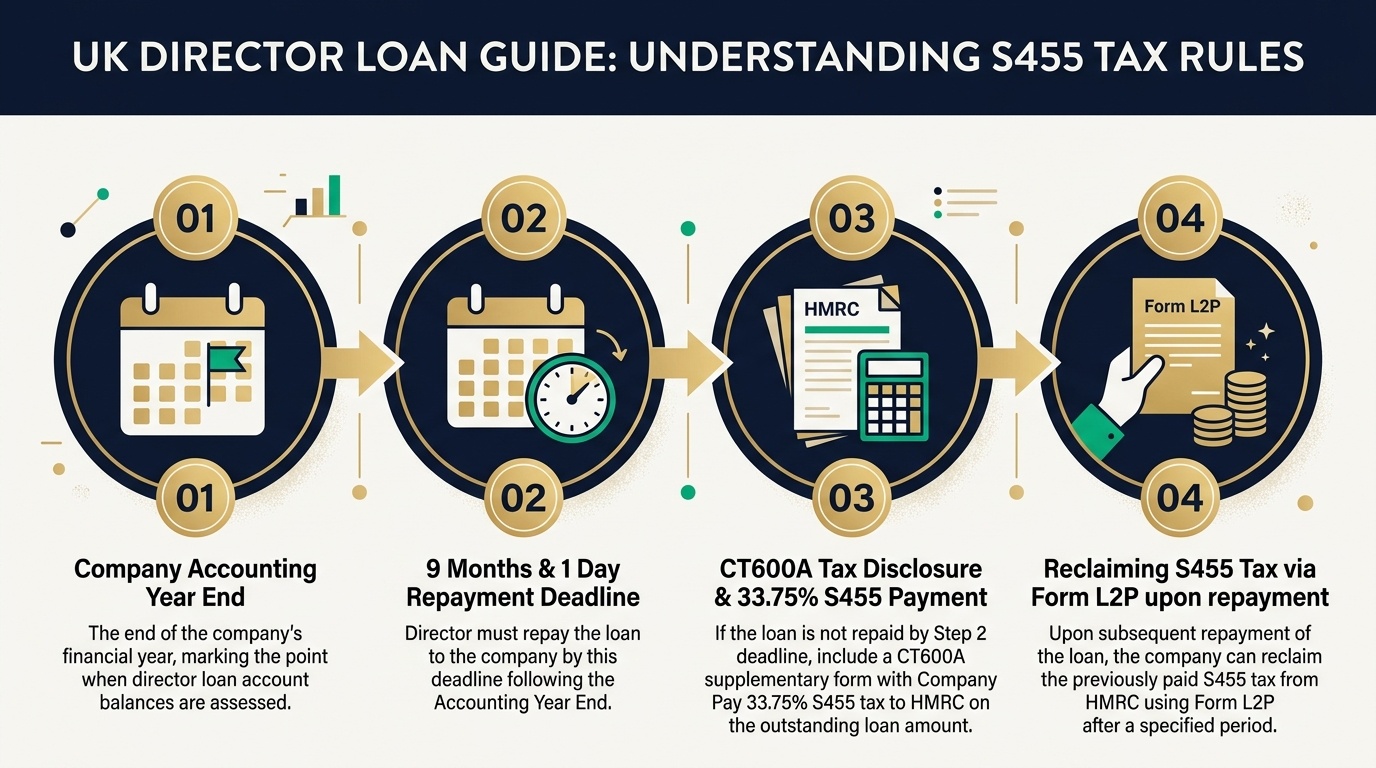
You have a statutory grace period to settle the overdrawn account. You must repay the loan in full within 9 months and 1 day after the end of the company’s Corporation Tax accounting period. This deadline matches the exact date when your annual Corporation Tax bill falls due.
Consider a practical operational example: If your limited company operates on a financial year running from 1 April to 31 March, your accounting period ends on 31 March 2026. The statutory deadline to repay any overdrawn director’s loan is 1 January 2027. If you owe the company £30,000 on 31 March 2026 and have not cleared that balance by 1 January 2027, the company must pay £10,125 (33.75% of £30,000) to HMRC alongside its normal Corporation Tax liability.
Reporting via Form CT600A
Every company with an overdrawn director’s loan balance at the balance sheet date must complete Form CT600A, a mandatory supplementary schedule attached to the main CT600 Company Tax Return. Form CT600A requires detailed disclosure of:
- The name of each debtor director or participator.
- The opening and closing loan balances during the accounting year.
- The exact dates and values of any repayments made within 9 months of year-end.
- The net amount subject to the 33.75% S455 tax levy.
- Any write-offs or releases executed during the period.
How to Reclaim Section 455 Tax from HMRC
Section 455 tax is not a final, unrecoverable charge. It functions as a temporary deposit held in escrow by the state. Once the director permanently repays the loan, or the company formally writes it off, the company has the legal right to reclaim every penny of the 33.75% tax back from HMRC.
However, the refund process comes with a frustrating timing restriction. HMRC will not process an S455 refund until 9 months and 1 day after the end of the accounting period in which the repayment or write-off took place. If your loan was outstanding at 31 March 2026, and you pay S455 tax in January 2027, then repay the loan in July 2027 (which falls in the accounting year ending 31 March 2028), HMRC will only refund the cash on 1 January 2029.
Claims for repayment submitted within two years of the accounting period end are processed via an online amendment to Form CT600A. Claims filed after two years must be submitted using HMRC Form L2P. Crucially, while HMRC repays the base tax, it does not refund any late-payment interest charged if the company paid its S455 tax after the original statutory deadline.
The 30-Day “Bed and Breakfasting” Anti-Avoidance Rules
Prior to statutory reforms, company owners used a loophole known as “bed and breakfasting”. A director would draw £40,000 across the year, borrow funds externally for 48 hours to pay down the DLA on day 364, and then immediately reborrow the £40,000 from the company on day 2 of the new accounting year. This paper transaction created the appearance of a clean year-end balance while permanently avoiding Section 455 tax.
HMRC closed this avoidance manoeuvre by inserting Sections 464A and 464B into the Corporation Tax Act 2010. Today, two strict anti-avoidance tests prevent artificial repayments:
1. The 30-Day Rule (£5,000 Threshold)
If an overdrawn director’s loan balance of £5,000 or more is repaid, but within 30 days before or after that repayment the director withdraws another loan of £5,000 or more from the company, the repayment is legally disregarded up to the value of the new borrowing. HMRC treats the original loan as having never been settled, triggering the 33.75% S455 tax charge on the full sum.
2. The Arrangements Rule (£15,000 Threshold)
Even if a director waits 31 or 60 days before reborrowing, HMRC enforces a wider subjective test. If an overdrawn loan of £15,000 or more is repaid, and at the time of repayment there were intentions, plans, or arrangements to borrow money again in the future, the repayment is disqualified. If company bank balances would have been insufficient to support the ongoing business without the planned reborrowing, HMRC will deem the transaction artificial and demand S455 tax plus penalties.
To make a genuine, legally compliant repayment, funds introduced by the director must remain in the company bank account permanently or come from a taxed dividend or a genuine personal capital source.
The £10,000 Benefit in Kind (BIK) & P11D Rules
Section 455 is a corporate tax charged on the company. Independent of this corporate rule, personal employment tax rules apply to the director under the Income Tax (Earnings and Pensions) Act 2003 (ITEPA).
When a limited company lends money to an employee or director without charging interest, or charges interest below market commercial rates, HMRC views the unpaid interest as a taxable employment perk: an interest-free or cheap beneficial loan.
The £10,000 De Minimis Threshold
Under statutory exemptions detailed in the HMRC Beneficial Loan Arrangements Guidance, beneficial loan rules do not apply if your total outstanding borrowing across all company accounts remains at or below £10,000 at all times throughout the tax year.
This £10,000 limit is a strict cliff-edge ceiling, not a tax allowance. If your overdrawn balance touches £10,001 for even a single afternoon, the entire loan loses its statutory exemption. The tax calculation applies to the total loan balance from day one, not just the £1 excess.
HMRC’s Official Rate of Interest and the Double Tax Charge
If your overdrawn balance exceeds £10,000 and you do not pay adequate commercial interest to the business, HMRC calculates a notional benefit based on their published Official Rate of Interest. For both the 2025/26 and 2026/27 tax years, the official rate is set at 3.75% per annum.
If a director holds an interest-free overdrawn loan of £50,000 across an entire tax year, the notional interest value is £1,875 (3.75% of £50,000). This triggers an immediate double tax charge:
- Personal Income Tax for the Director: The £1,875 is reported on Form P11D and treated as taxable employment earnings on the director’s Self Assessment return. A higher-rate (40%) taxpayer pays £750 in personal tax.
- Class 1A National Insurance for the Company: The company must pay Class 1A employer NIC on the benefit value at 13.8%, for a direct corporate cost of £258.75.
To eliminate this Benefit in Kind tax charge entirely, the director must formally pay interest to the company at or above 3.75% before 6 July following the end of the tax year. Note that any interest paid by a director becomes taxable trading income within the company, subject to standard UK Corporation Tax rates between 19% and 25%.
How to Clear an Overdrawn Director’s Loan Account Legally
When an accounting period closes with an overdrawn balance, directors have several compliant mechanisms to clear the debt before the 9-month Section 455 deadline expires. The best path depends on the company’s retained profits, your personal liquidity, and your marginal tax rate.
| Clearing Mechanism | Company Tax Impact | Personal Tax Impact | Key Legal Requirement |
|---|---|---|---|
| 1. Personal Cash Repayment | Zero tax (DLA returns to £0) | Zero personal tax | Must observe 30-day anti-avoidance rules |
| 2. Voted Dividend Distribution | Paid from post-tax profits (no CT deduction) | Dividend tax (8.75% basic / 33.75% higher) | Company must have positive retained reserves |
| 3. Bonus / PAYE Salary | Deductible expense against Corporation Tax | Income Tax (20-45%) + Employee NIC (8-2%) | Company must pay 13.8% Employer NIC via RTI |
| 4. Expense Offsetting | Allowable business expense (reduces CT) | Completely tax-free reimbursement | Must hold valid VAT receipts / mileage logs |
Method 1: Declaring a Dividend
The most common method for owner-managers is voting a dividend to credit the loan account. Instead of transferring cash to your personal account, the dividend amount is credited against the DLA ledger, reducing or extinguishing the overdrawn balance.
However, you cannot simply declare a dividend on paper. Company law strictly dictates that dividends can only be paid out of distributable reserves: cumulative realised profits after deducting Corporation Tax liabilities. If you vote a dividend when the company has insufficient retained profits, it is classed as an “illegal dividend” (ultra vires). HMRC will reclassify the distribution as an overdrawn loan, reinstating your Section 455 liability and potentially exposing directors to personal restitution claims from creditors.
Method 2: Voting a Director Bonus
If the company lacks distributable profit reserves to support a dividend, the board can award the director a gross salary bonus. The net earnings after PAYE and National Insurance deductions are credited to the DLA to clear the overdrawn balance.
While salary attracts higher personal Income Tax and National Insurance rates than dividends, gross salary is classed as an allowable commercial trading expense. It reduces your company’s taxable profit, saving between 19% and 25% in Corporation Tax. This interaction is a core part of structuring corporate remuneration; review our detailed analysis on how to reduce corporation tax legally by balancing salary deductions against dividend income.
Method 3: Expense Set-Off
Directors often pay for business travel, client meals, home-office equipment, and software out of pocket without logging formal expense claims. Auditing historical receipts often uncovers thousands of pounds in unreimbursed commercial outlays. Crediting verified business expenses against your DLA reduces the overdrawn loan balance without triggering any Income Tax, National Insurance, or Corporation Tax liabilities.
The Lethal Traps: Writing Off a Loan & Company Insolvency
When cash or dividends are unavailable, directors often ask whether the company can simply “write off” or forgive the loan. While legally permissible under company resolutions, writing off an overdrawn DLA triggers catastrophic tax consequences and personal liability risks.
The Punitive Tax Treatment of a Written-Off DLA
When a limited company formally releases a director’s loan, the outstanding debt is deemed to be a distribution of income to the director under Section 415 of the Income Tax (Trading and Other Income) Act 2005 (ITTOIA):
- Personal Income Tax: The director must declare the entire gross written-off sum on their Self Assessment tax return. It is taxed at dividend rates (8.75% basic rate, 33.75% higher rate, and 39.35% additional rate).
- Class 1 National Insurance: If the director is an office-holder or employee and the loan waiver is deemed to arise from employment rather than shareholding, HMRC enforces employee and employer Class 1 NIC through payroll.
- Disallowed Corporation Tax Deduction: Unlike genuine bad business debts owed by third-party commercial clients, a company cannot deduct a written-off director’s loan as an expense against Corporation Tax.
While the company can reclaim any historic Section 455 tax previously deposited with HMRC, the director faces an immediate, irreversible personal tax demand.
The Insolvency Trap: Piercing the Corporate Veil
The biggest operational hazard of an overdrawn Director’s Loan Account arises when a business faces financial distress. If the company enters Creditors’ Voluntary Liquidation (CVL) or compulsory winding up, limited liability does not protect you from an overdrawn DLA.
An overdrawn loan account is recorded on the balance sheet as a company asset. When an Insolvency Practitioner (liquidator) assumes control, their statutory fiduciary duty is to recover all assets for the benefit of creditors. Under Section 212 of the Insolvency Act 1986, liquidators have sweeping legal powers to examine directors for misfeasance and breach of duty.
The liquidator will issue formal demand letters requiring you to repay every penny of the overdrawn loan from your personal assets. If you cannot pay, the liquidator can obtain County Court Judgments (CCJs), place charging orders over your family home, freeze your personal bank accounts, and petition for your personal bankruptcy. Many directors incorporate a company under the mistaken assumption that limited liability insulates them from all corporate liabilities; review our guide on registering a limited company in the UK to understand the statutory responsibilities and fiduciary boundaries imposed on directors.
In-Credit Director’s Loans: How to Charge Your Company Interest
When you provide capital to fund company expansion or cover working capital deficits, your DLA sits in credit. While you can draw down this capital at any time completely tax-free, you can also optimise your tax position by charging the company commercial interest on the loan balance.
Charging interest on a director’s loan delivers two substantial tax efficiencies:
- Corporation Tax Deduction for the Company: The interest paid to the director is classed as a legitimate business finance expense. It reduces the company’s taxable trading profits, saving Corporation Tax at rates between 19% and 25%. If your company requires external growth funding alongside director capital, explore how alternative facilities function in our guide to cash flow lending for UK businesses.
- Personal Savings Allowance Utilisation: UK basic rate taxpayers can earn up to £1,000 in savings interest tax-free each year under the Personal Savings Allowance (£500 for higher rate taxpayers). A director can extract up to £1,000 in interest from their company without paying any personal Income Tax or National Insurance.
Withholding Tax Compliance and Form CT61
You cannot simply transfer interest from the company bank account to your personal account. Under UK tax law, a company paying annual interest to an individual must deduct 20% basic rate Income Tax at source.
The company must register for a Form CT61 account with HMRC. Each quarter, the company must submit a paper Form CT61 return, detailing the gross interest paid, and remit the 20% withheld tax directly to HMRC. The director then declares the gross interest and tax deducted on their personal Self Assessment return. If their total interest income falls within their Personal Savings Allowance, HMRC refunds the 20% tax to the director.
Frequently Asked Questions
What happens if I cannot repay my director’s loan within 9 months?
If an overdrawn director’s loan is not repaid within 9 months and 1 day of your company’s accounting period end, the company must pay a 33.75% Section 455 Corporation Tax penalty to HMRC on the outstanding balance. The company reports the charge on Form CT600A. The company can reclaim this tax once the loan is permanently settled, but HMRC does not process the refund until 9 months after the accounting period in which repayment occurred.
Can I have an interest-free director’s loan in the UK?
Yes, provided your total outstanding borrowing across all accounts remains at or below £10,000 at all times during the tax year. If your loan exceeds £10,000 and the company charges zero interest (or interest below HMRC’s official rate of 3.75%), it is classed as an employment Benefit in Kind (BIK). The company must file a Form P11D, pay 13.8% Class 1A National Insurance, and the director pays personal Income Tax on the benefit.
How does HMRC find out about an overdrawn director’s loan?
UK companies must disclose all director transactions, opening and closing loan balances, and repayments on Form CT600A alongside their annual Corporation Tax return. In addition, under FRS 102 and FRS 105, overdrawn DLAs must be disclosed in the notes to the statutory financial accounts filed at Companies House. HMRC cross-matches company returns, P11D filings, and director Self Assessment returns using automated risk-profiling algorithms.
Can an overdrawn director’s loan cause personal bankruptcy?
Yes. If your company enters formal insolvency, administration, or liquidation, an overdrawn director’s loan is classed as a corporate asset. The appointed liquidator has statutory obligations to collect all outstanding debts for creditors. If you fail to repay the balance, liquidators can secure personal CCJs, charge your residential property, or initiate personal bankruptcy proceedings against you.
What is the difference between a director’s loan and a dividend?
A dividend is a permanent distribution of post-tax company profits to shareholders that never needs to be repaid. Dividends attract personal dividend tax (8.75%, 33.75%, or 39.35%) and can be paid only if the company has positive retained profit reserves. A director’s loan is borrowed capital that remains an asset of the company and must be repaid, triggering S455 tax and BIK penalties if left unpaid or overdrawn.
Can my company lend money to my spouse or children?
Under Section 455 anti-avoidance rules, loans made to “associates” of a director or shareholder (including spouses, civil partners, parents, children, and business partners) are treated identically to loans made to the director directly. The company faces the same 33.75% S455 tax charge, £10,000 BIK thresholds, and 9-month repayment rules.
What to Do Next: Director’s Loan Compliance Action Checklist
Managing a Director’s Loan Account requires disciplined financial oversight to prevent accidental tax bills. If your company operates with an overdrawn balance or you plan to draw funds in the coming financial year, execute these four compliance controls:
- Audit Your Current DLA Balance Monthly: Request an up-to-date DLA ledger from your bookkeeper at every month-end. Verify whether the balance is approaching the critical £10,000 Benefit in Kind threshold before making further drawings.
- Map Your 9-Month Statutory Deadline: Identify your exact Corporation Tax year-end date. Mark your calendar for exactly 9 months and 1 day post year-end to ensure dividends are formally voted, salary bonuses processed, or cash transferred before the Section 455 tax crystallises.
- Verify Distributable Profit Reserves: Never vote an interim dividend to clear an overdrawn loan without producing management accounts confirming that post-tax profits exist. If profit reserves are insufficient, structure the clearing through net salary or allowable expense set-offs.
- Review Commercial Protection & Insurance: Ensure your corporate operations are backed by appropriate commercial safeguards, including director compliance checks and dedicated public liability insurance and professional indemnity policies to insulate your enterprise from external liabilities.
A Director’s Loan Account provides valuable short-term flexibility for UK company founders, but treating company bank reserves as personal funds without strict compliance oversight can trigger expensive HMRC penalties. Work closely with an accredited ICAEW or ACCA chartered accountant to structure your director withdrawals, document board minutes, and maintain a compliant capital extraction strategy.