Quick Answer: UK Corporation Tax Rates 2026
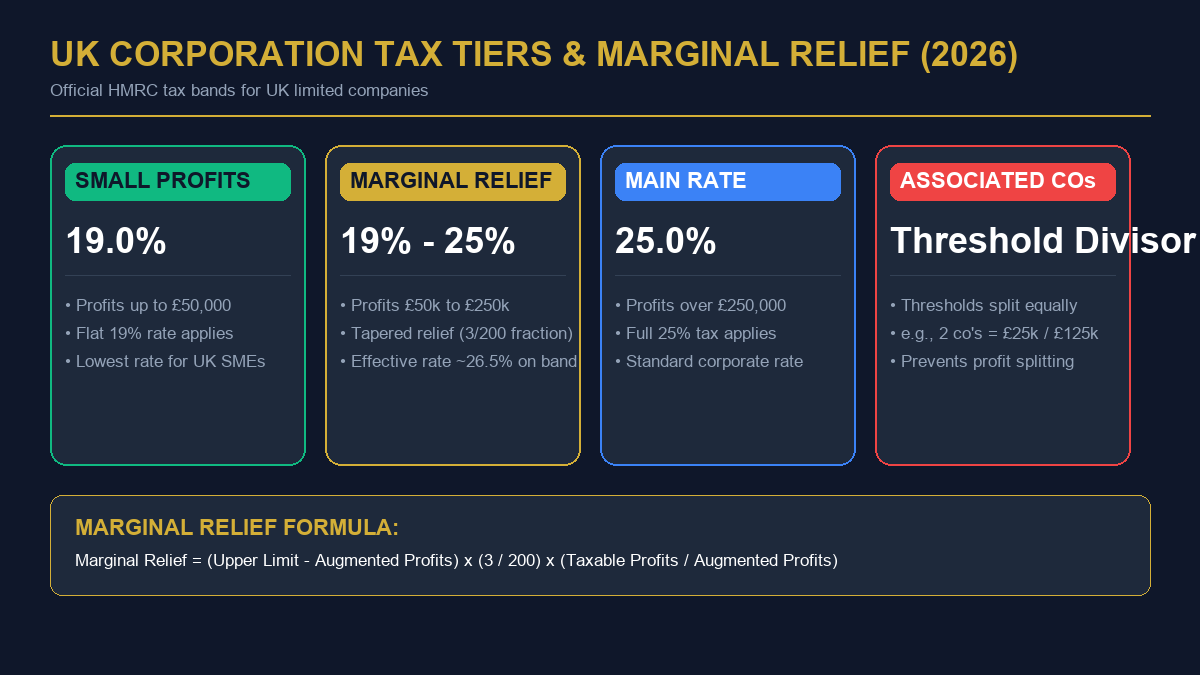
In 2026, the UK Corporation Tax rate is 19% for limited companies with taxable augmented profits up to £50,000 (Small Profits Rate) and 25% for profits exceeding £250,000 (Main Rate). Companies with profits between £50,000 and £250,000 qualify for Marginal Relief, which applies a statutory fraction of 3/200 (0.015) to reduce the effective tax rate from 25% down toward 19%. Thresholds are divided equally among “associated companies” under common control. Corporation Tax must be paid to HMRC within 9 months and 1 day after the accounting year end.
Key Takeaways
- Small Profits Rate remains 19% on augmented profits up to £50,000; the Main Rate is 25% on profits over £250,000.
- Marginal Relief smooths the transition on profits between £50,000 and £250,000 using the standard 3/200 multiplier.
- Having associated companies proportionately reduces the £50,000 and £250,000 profit thresholds.
- Corporation Tax payment deadline is strictly 9 months + 1 day after the accounting period ends, while the CT600 return is due within 12 months.
For UK limited company directors and financial controllers, managing corporate tax liabilities represents a central pillar of annual balance-sheet planning. Understanding how taxable profits are assessed under HMRC’s tiered tax system is critical for accurate financial forecasting, dividend distributions, and working capital management.
According to official statistics from HMRC Corporation Tax guidance on GOV.UK, over 2.5 million UK companies file annual company tax returns. The multi-tiered system requires directors to pay close attention to augmented profit calculations and associated company rules to avoid underpayment penalties.
This guide explains the 2026 UK Corporation Tax rates, breaks down the exact Marginal Relief calculation formula with worked examples, details the associated company rules, and provides the statutory annual compliance timeline.
1. UK Corporation Tax Rates & Profit Bands (2026)
UK Corporation Tax applies to all profits generated by UK resident limited companies, foreign companies with a UK branch or office, and unincorporated associations. In 2026, corporate profits are taxed across three tiers:
| Profit Tier | Augmented Profit Range | Corporation Tax Rate | Applicability |
|---|---|---|---|
| Small Profits Rate (SPR) | £0 to £50,000 | 19.0% | UK active trading SMEs with no associated companies |
| Marginal Relief Band | £50,001 to £250,000 | 19% to 25% (Tapered) | Gradual transition (effective marginal rate 26.5%) |
| Main Rate | Over £250,000 | 25.0% | All profits taxed at full 25% main rate |
If you are incorporating a new limited company to begin trading, review our step-by-step guide on how to register a company in the UK.
2. How Marginal Relief Works (Formula & Calculation)
Without Marginal Relief, a company earning £50,001 would instantly jump from a 19% tax rate to a 25% tax rate, creating a cliff-edge disincentive for business growth. Marginal Relief eliminates this issue by providing a sliding-scale tax deduction.
The Statutory Marginal Relief Formula:
Worked Example:
A UK trading company generates £120,000 in taxable profit with no exempt distributions or associated companies:
- Main Rate Tax (at 25%): £120,000 × 25% = £30,000.
- Upper Limit Gap: £250,000 – £120,000 = £130,000.
- Marginal Relief Deduction: £130,000 × (3 / 200) = £1,950.
- Net Corporation Tax Payable: £30,000 – £1,950 = £28,050.
- Effective Tax Rate: £28,050 / £120,000 = 23.375%.
For company directors balancing corporate tax retention against personal income extraction, read our analysis of the optimal salary and dividend split for UK directors.
3. Associated Companies Rules: The Anti-Fragmentation Rule
Under HMRC rules, two or more companies are “associated” if one has control over the other, or if both are under the control of the same person or group of persons (such as a director owning two separate limited companies).
When associated companies exist, the £50,000 and £250,000 thresholds are divided equally by the total number of associated companies (1 + N):
- 1 Company (No associated): Lower limit £50,000 | Upper limit £250,000.
- 2 Associated Companies: Lower limit £25,000 | Upper limit £125,000 each.
- 3 Associated Companies: Lower limit £16,667 | Upper limit £83,333 each.
- 4 Associated Companies: Lower limit £12,500 | Upper limit £62,500 each.
Holding dormant companies or purely passive holding entities does not trigger the associated company reduction if strict non-trading conditions are met.
4. Corporation Tax Deadlines & Cash Flow Management
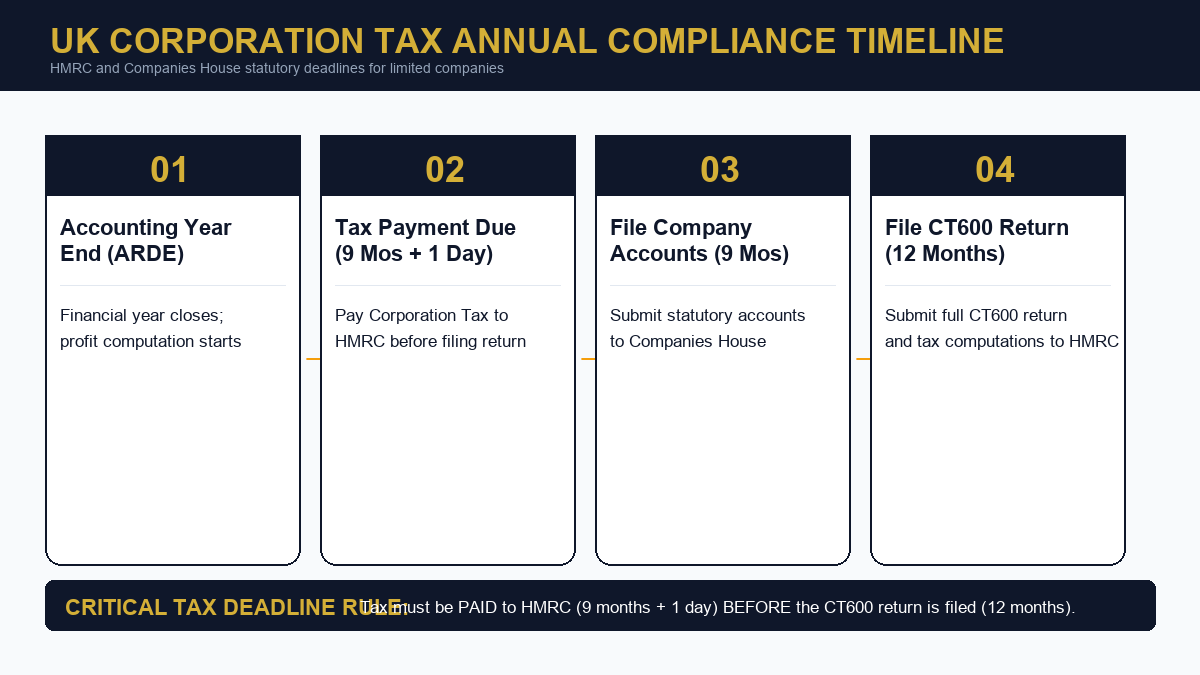
Unlike personal income tax where payment and filing deadlines coincide on 31 January, Corporation Tax operates on distinct statutory deadlines:
- Payment Deadline: Exactly 9 months and 1 day after the end of your accounting period. For example, if your year-end is 31 March 2026, tax must be paid by 1 January 2027.
- Filing Deadline (Form CT600): Exactly 12 months after the end of your accounting period (31 March 2027 in the above example).
Because payment is due before the tax return is officially filed, accurate interim cash forecasting is critical. Ensure your business models upcoming tax liabilities using our guide on small business cash flow forecasting in 2026.
For businesses with employees, ensure your payroll deductions reflect recent Class 1 rate changes detailed in our guide to employer national insurance contributions 2026 rates.
5. Legitimate Corporation Tax Reduction Strategies
UK businesses can implement several approved tax planning methods to reduce taxable total profits before Corporation Tax is assessed:
1. Full Expensing & Annual Investment Allowance (AIA)
The Annual Investment Allowance (AIA) allows 100% first-year tax relief on qualifying plant and machinery investments up to £1 million per year. Permanent Full Expensing allows uncapped 100% first-year deductions on brand-new main rate equipment.
2. Employer Pension Contributions
Direct employer pension contributions paid on behalf of directors or employees are fully allowable business expenses, reducing net taxable profit pound-for-pound while remaining exempt from Employer NICs. Check statutory auto-enrolment rules in our guide on workplace pension compliance UK 2026.
3. Commercial Real Estate SPVs
Holding property assets within dedicated limited company Special Purpose Vehicles (SPVs) ensures 100% of mortgage interest is tax-deductible against rental income. For complete details, see our guide to limited company mortgages in the UK.
6. Frequently Asked Questions
What is the difference between taxable total profits and augmented profits?
Taxable total profits are your company’s trading profits, rental income, and capital gains minus allowable deductions. Augmented profits equal taxable total profits plus exempt distributions (such as dividends received from non-associated companies). Augmented profits determine which tax rate tier applies.
Your Next Actions
- Audit Profit Expectations: Estimate your annual augmented profits to identify whether your company sits in the 19%, Marginal Relief, or 25% band.
- Count Associated Companies: Review all corporate shareholdings held by directors to calculate your adjusted £50k/£250k thresholds.
- Utilize Capital Allowances: Schedule necessary equipment and technology purchases before year-end to claim 100% first-year tax write-offs.
- Explore Tools: Access financial modeling calculators in our Business Tools Hub.
Editorial Team & Signature
Written by Oliver Carpenter, Founder & Editor-in-Chief at Elite Business Journal. Published August 2026.
Analyze how payroll taxes impact your company profit margins with our guide to employer national insurance contributions 2026.
As trading revenue approaches the £90,000 threshold, ensure compliance by checking when do you need to register for VAT.
For an overarching analysis of corporate tax, VAT, and capital allowances, explore our pillar guide on business tax in the UK.